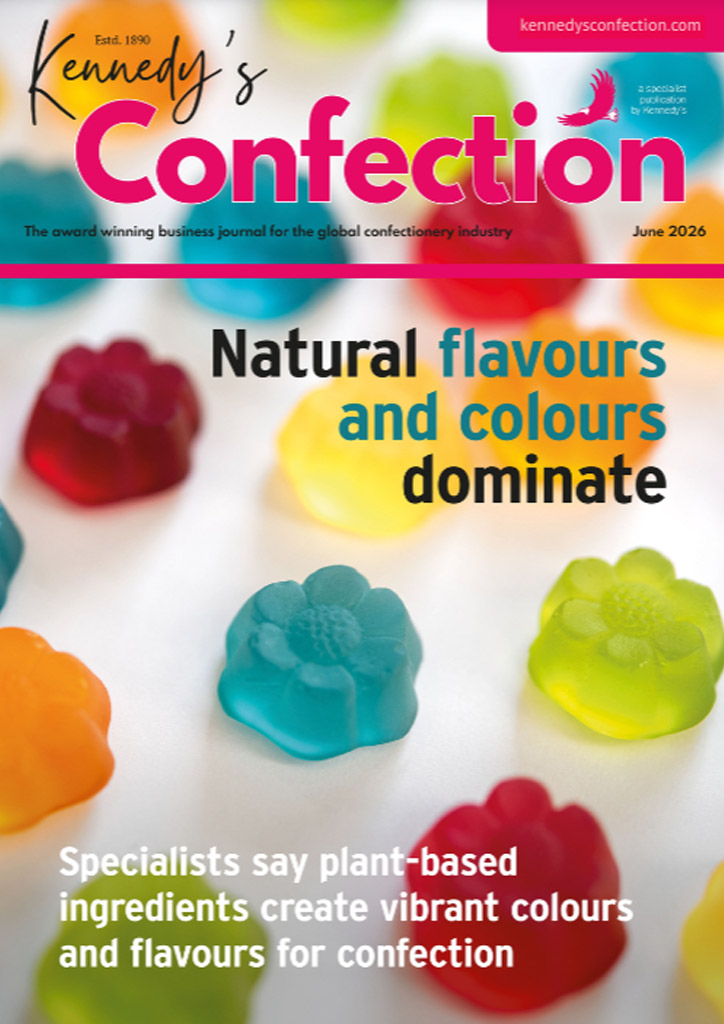

From vibrant colours to exotic flavours, Kennedy’s Confection Editor, Kiran Grewal, explores how confectionery is taking centre stage as a platform for self-expression, exploration, and wellness.
Colour and flavour ingredients play a critical role in the mass production of confectionery. Whether it’s candy, chocolate, or gum, these ingredients are responsible for creating the distinct taste and appearance of each product. In the highly competitive world of confectionery, manufacturers need to continuously innovate and create new flavour and colour combinations to stand out from their competitors. The use of colour and flavour ingredients not only enhances the sensory experience of the consumer but also helps to increase the shelf-life and stability of the product. As a result, the selection and application of these ingredients require careful consideration to ensure consistent quality, taste, and appearance of the final product.
In today’s fast-paced world, consumers are increasingly seeking opportunities to express themselves and find moments of escape. And what better way to do that than through the foods and beverages we consume every day? Colour is one of the most important sensory cues we have when it comes to choosing what to eat. It has a big impact on our psychology, influencing what we see, what we taste and what we feel while we’re doing it. From vibrant colours to exotic flavours, confectionery is taking centre stage as a platform for self-expression, exploration, and wellness. Blissful blue tones, evoking open skies and oceans, are becoming popular choices for limited-edition products, satisfying consumer demand for experiential and fantastical moments. Research shows that 66% of global consumers find new and experimental colours exciting, driving demand for dream-like and fantasy colours and flavours. Hélène Moeller, Vice President, Global Product Marketing, Flavours and Colours, ADM, predicts: “We anticipate dream-like and fantasy colours and flavours like mermaid, unicorn, dragon, blue raspberry and rainbow sherbet will emerge throughout the confectionery market.”
According to recent research, 74% of global consumers are drawn to new and unusual or exotic flavours in their food and drink products. Confectionery that boasts bright colours and a variety of flavours from sweet to savoury, helps provide a sense of experiential eating for consumers looking for new treats. Eye-catching confections invite exploration through the use of lively colours, as well as textures that excite and delight, such as crunchy, crispy, gooey, bubbly and chewy. Hélène says: “These congruous or contrasting colours and textures pair well with regional profiles like tajin with slight spicy and citrusy notes, sharp finger lime and juicy dragon fruit for the ultimate sensorial experiences.” She continues: “We expect to see this echoed in the confectionery category, with a flourish of flavours and colours that reflect consumers’ appetites for exploration, surprise, and wellness in all different forms.”
One of the most striking trends is the preference for bright and intense colours in food products, with 56% of consumers worldwide favouring such products. “Vibrant pinks are bringing intense expression to confectionery items, such as lollipops, gummies, hard candies and more. Other colours that help shift consumer moods toward brighter and lighter moments are shades of blue, teal and purple,” explains Hélène.[Text Wrapping Break][Text Wrapping Break]Plus, zingy orange and sunny yellow are colours known for their emotional appeal to elevate spirits. Such colours also align with citrus, which remains the most classic flavour profile. “In fact,” Hélène adds, “citrus accounts for nearly 30% of new product launches.”
Pablo Elizondo, Head of R&D at CAPOL Inc, agrees: “Red shades are one of the most popular colours in all types of candy, from a bright fire-engine red to pinkish red and pastel tones. While many colours are easily achievable with natural dyes, like for example pinks with red beet extracts, the search for saturated and stable reds continues to drive innovation in the colour industry.
“We see the tendency for optimistic, powerful colour shades also reflected in the Pantone® colour of the year for 2023. ‘Viva Magenta’’ is a strong and pulsating red hue that is set to promote joy. It lays the ground for a strongly saturated hue, and our VIVAPIGMENTS® are here to follow suit. Our natural colour pigments are rooted in nature, just like Viva Magenta, and thanks to using high-intensity extracts and a patented encapsulation technology, they can achieve bright shades in a variety of confectionery applications.”
Pablo adds: “When it comes to flavours, we have observed two main trends at the start of the year. The push for mixing sweet flavours with a little heat, and for reaching back to basic flavour profiles, but mixing them together: instead of a specific berry or a specific type of apple, looking for a balanced berry mix, or a balanced apple mix.”
Consumers are also seeking out treats that support emotional well-being, signalling a shift towards self-care in the confectionery category. “Lavender, as a colour and flavour, is standing out in this area,” explains Hélène, “evoking feelings of positivity, optimism, and relaxation, which is increasingly important for consumers as they consider their holistic well-being.” Botanicals like relaxing chamomile are also gaining prominence in gummies, hard candies, chocolate truffles, and candy melts, providing consumers with a range of options to satisfy their cravings for both taste and wellness.
Formulation and industry challenges
Colour and flavour are of particular importance in the confectionery space, but they don’t come without some formulation hurdles when creating products consumers crave. It can be difficult to create bright and bold colours that can also withstand different processing conditions, as well as other challenges including colour interactions, solubility, packaging and shelf life.
Hélène explains: “Markedly, our cutting-edge technologies help brands address these challenges and create visually appealing confectionery. Specifically, our proprietary and patented micronised ‘Colours from Nature™’ platform helps produce a full spectrum of colours derived from natural sources. The plating characteristics in our colour solutions can help deliver bright, clean and even top coatings, as well as stop flashing, streaking and bleeding in different candy formats.
An important topic in the industry remains the replacement of titanium dioxide. The ban on titanium dioxide (TiO2) as a food additive in Europe has launched a race for the development of an appropriate alternative. The recent judging of the EU regulators that declared the EU Commission’s regulation as an error in assessment may question the status of TiO2 once again, but the industry has been moving away from the additive for some time now. While the industry is still innovating to find a turn-key solution that will work with a comparable versatility, efficiency, and exceptional whitening effect in every application, it is likely that solutions will be application specific. When it comes to sugar dragées for example, titanium dioxide, or TiO2, has been for long the standard for pan-coating of the hard-panned white layer between an often dark-coloured core and a bright colour coating. An alternative solution in panning needs to achieve efficient coverage of the centre to increase the brightness of overlaying colours. [Text Wrapping Break][Text Wrapping Break]“We use our patented extraction technology to create vivid colours while mitigating off-notes or unwanted aromas coming from different ingredients. By using our extraction technology, we can eliminate these off-notes, while also removing proteins, sugars and starches, to produce vibrant colours that can withstand the most sensitive and challenging formulation conditions,” says Hélène. “Our PearlEdge™ line of proprietary white colour solutions include PearlEdge™ Silk and Satin patent-pending technology, which acts as a base coat and enables even more vibrantly coloured confections. Our PearlEdge™ Silk, Satin and Shine solutions also reduce overprocessing for panned confections and hard candies, ensuring even coating and glossy surfaces, respectively.” she adds.
“Our VIVAPIGMENTS® White, a product that is based on calcium carbonate encapsulated with rice protein, has proven to be a great solution in this regard due to its opacity. VIVAPIGMENTS® White can be dispersed directly in the sugar solution and used in the engrossing process. Initial feedback from our customers confirmed that they were able to achieve good results in production-scale trials even at a dosage considered low for an alternative whitening agent,” Pablo weighs in.
The bright white application can also be used in chocolate too. Lesya Melechyn, Category Lead Chocolate & Confectionery, ofi, explains: “An exciting ingredient we’ve developed is our deZaan Moonlight cocoa butter for chocolate and confectionery. This bright white breakthrough offers an attractive and brilliant visual contrast. With minimal residual cocoa taste and aroma, this also allows the flavours of other ingredients to shine through. For trade shows like Food Ingredients Europe, our R&D teams across cocoa, spices, nuts and coffee developed enticing flavour and colour combinations using Moonlight. The results included ginger, hazelnut and coffee varieties.”
Consumers are also more conscious about the ingredients in food products and are taking a closer look at labels, however, this does not mean they are ready to sacrifice the brightly coloured products with the exciting flavours they are used to. Pablo says: “We see that the trend for mindful snacking and cleaner labelling has been with the industry for quite a while now and still there are no signs of slowing down. When we turn this observation into a consumer’s expectation, very simply put, this often translates to ‘give me the same, but naturally’. This is specifically true for markets like North America, where the transition from synthetic to natural colouring is in full swing. In Europe, the expectation bar often reaches even higher with colouring foods that do not require labelling as a colour or additive,” he explains.
Plant-based flavour profiles in confectionery and chocolate
Plant-based ingredients offer a wide range of flavour profiles that can be used to create unique and innovative confectionery products. By using ingredients like fruits, nuts, spices, and herbs, confectioners can create products that are not only delicious but also appeal to consumers who are looking for healthier and more sustainable options.
One of the benefits of using plant-based ingredients is that they are often rich in flavour compounds that can add depth and complexity to confectionery products. For example, vanilla, cinnamon, and nutmeg are all plant-based ingredients that can be used to enhance the flavour of a wide range of confectionery products.
In addition, plant-based ingredients can also provide a range of health benefits that are increasingly important to consumers. For example, many fruits and nuts are high in antioxidants and other beneficial compounds that can support overall health and well-being. “Nuts really can be the solution here – in our recent trials, we found that chocolate using our almond protein powder has the most similar qualities to dairy chocolate.Meanwhile, the smooth texture and delicious flavour of hazelnuts is a great match for chocolate,” says Lesya. By incorporating these ingredients into confectionery products, manufacturers can create products that are not only delicious but also provide a range of health benefits.
Finally, plant-based ingredients are often more sustainable than animal-based ingredients, which is becoming increasingly important to environmentally conscious consumers. By using plant-based ingredients, confectioners can create products that are not only tasty but also environmentally friendly, which can be a major selling point for many consumers.
Lesya continues: “We also recently revealed our trends for chocolate and confectionery for 2023, where we predicted that consumers will seek new taste experiences from underused ingredients. For example, there’s an opportunity in sugar reduction for chefs and manufacturers to introduce flavour variation and address nutritional factors. We’ve also looked at using the right cocoa for reduced or sugar-free chocolate and confectionery recipes that don’t compromise on flavour. We’ve found that red alkalised cocoa powders can help mask off notes from high-intensity sweeteners and plant-based proteins like pea and soy.”[Text Wrapping Break]
The confectionery industry is undergoing a transformation as it adapts to changing consumer desires for self-expression, escapism, and wellness. The evolution of flavours and colours in this category reflects the need for sensory experiences that align with consumers’ lifestyles and values, creating a new era of sweet treats that cater to our every desire. Hélène concludes: “Above all else, consumers are actively seeking new ways to experience foods. This bodes well for the confectionery space where unique and exciting flavours and colours can be used to elevate consumers’ favourite candies to create whimsical and adventurous experiences.”
Pablo adds: We know that consumers like to be adventurous and are always looking for something new. Candy manufacturers have to stay inventive to keep up with this desire. Colours and flavours are a vital part in the first look and the sensory experience of a product. An example of innovation in this sense is to work with a two-part product, where each part is a specific colour and flavour. They can be enjoyed independently, or they can be mixed together to create a whole new sensory experience.”
Editorial contact:
Editor: Kiran Grewal kgrewal@kennedys.co.uk