
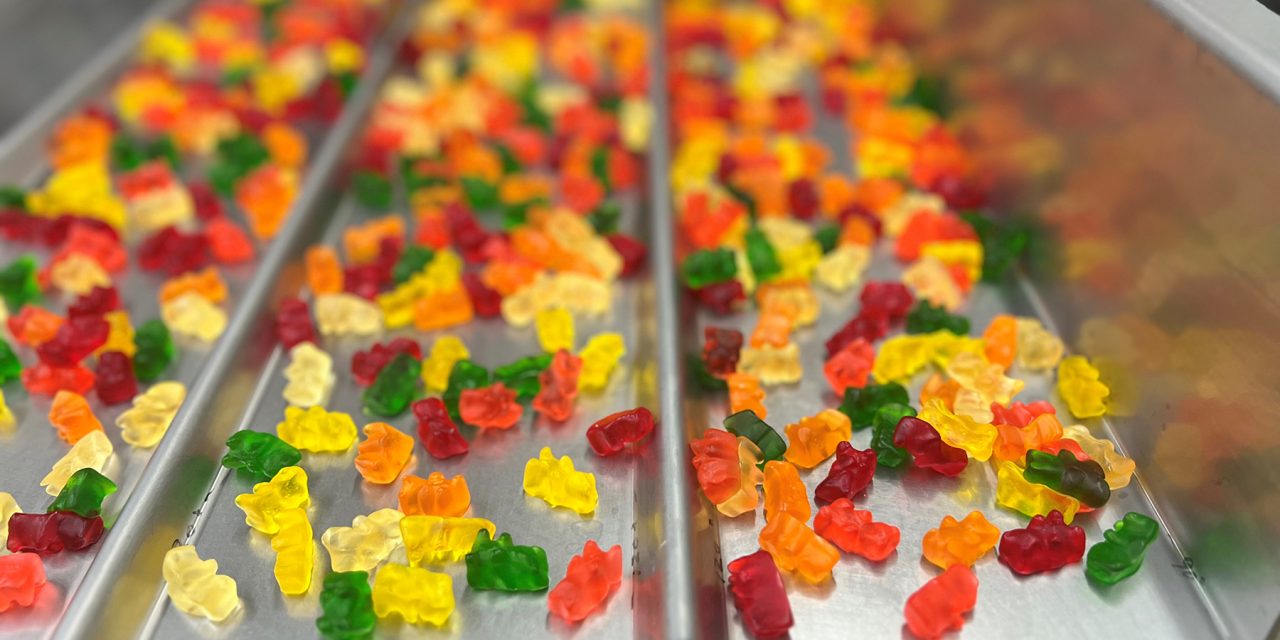
Suzanne Callander reports on the importance of making the right conveying choices to meet the needs of the product being moved.
There are many different factors to consider when choosing the best conveyor for a specific confectionery processing or packaging line – product handling requirements, capacity demands, and total cost of ownership as just a few of the key considerations.
Offering his thoughts on the different conveying solutions available, Rudy Sanchez, Food Handling Systems Product Manager at Key Technology, points out that belt conveyors typically offer the lowest initial capital cost of all the conveying solutions, which is why they are so popular. Rudy goes on to argue, however, that this simple cost analysis is short sighted. Explaining further, he says: “High maintenance and cleaning costs will quickly inflate the total cost of ownership of a belt conveyor. Although the initial price tag for vibratory conveyors and horizontal-motion conveyors is often higher, the larger upfront cost is quickly recovered because they can cost so much less to maintain and clean than a belt conveyor.”
However, Rudy does agree that some applications are best served with belt conveyors – such as when a significant change in elevation is needed. “Packaged product can also be conveyed effectively with a belt conveyor, when hygiene is less of a concern,” he says.
A sanitary solution
Rudy believes, that when compared to belt conveyors, vibratory conveyors are inherently more sanitary and easier to clean, featuring stainless-steel product zones and no belt to pulley/gear laminations. “The robust design and minimal wear parts of a vibratory conveyor also improves reliability and reduces maintenance, which results in a lower total cost of ownership over the life of the conveyor,” he says. “Transfer points from vibratory conveyors can be much lower and product containment is 100% compared to belt conveyor, which typically require scrapers.
“Vibratory conveyors are particularly good at spreading confectionery products – such as when feeding an optical sorter, and for product distribution – as gates can be easily opened and closed to divert product to multiple points.” Rudy then says that vibratory conveyors are also a good choice for moving sticky or oily confectionery products, because the slight vertical lift will help move product forward. Vibratory conveyors equipped with specialised screens are also available, to size product, remove fines, or to remove excess sugar, for example. Electromagnetic vibratory conveyors, which can start and stop quickly, are a good fit for scale feed applications on packaging lines, where accurate metering to scales greatly enhances scale and bagger performance. If the product is prone to blinding – sticking to the surface media due to moisture build up – another type of vibratory conveyor, such as a diverging bar grader, may offer a good solution.
Rudy believes that horizontal-motion conveyors offer the gentlest handling and the easiest cleaning of all vibratory conveyor types due to its sliding product motion. In particular, they are well-suited to use with products covered with sugar when it is important to handle the product gently so as not to not lose the coating. They are also suitable for conveying wrapped hard candies because the horizontal motion reduces noise, and for gummy candies that are coated in an oily residue that must be protected. Additionally, the lower maintenance requirements of horizontal-motion conveyors can also lead to a lower total cost of ownership than belt conveyors.
“To select the perfect conveyor for each situation, confectionery processors should assess the strengths and weaknesses of each conveyor type and judge the benefits based on the specific application. For help navigating this complicated analysis, confectionery processors can work with an experienced equipment supplier to identify the conveying solutions that create competitive advantages by improving the performance on the line,” concludes Rudy.
Testing, testing, testing
Before specifying any conveying solution, it is important to test, and sometimes even retest, the products that need to be moved on the conveyor systems under consideration. All confectionery products and their raw ingredients are likely to have unique properties that will dictate how they respond to the strains and stressors of transportation.
Testing will give important information about a product’s flow characteristics, throughput, breakage possibility, safety precautions, cleaning requirements, and maintenance procedures. It is also essential to ensure precise sizing and evaluation of equipment.
According to Automated Handling Solutions, to gain a good grasp of the material properties of a product before purchasing a conveying solution, many in the food industry are now undertaking material testing beforehand. Powders can be assessed to determine bulk density, moisture content, and angle of repose to determine flowability in a fully furnished laboratory.
These tests can yield a wealth of information that is being used to solve product-specific issues with powder, including stickiness, abrasiveness, compaction, and inadequate flowability. These elements may even be important when choosing between tubular cable drag, flexible screws, and aeromechanical conveyor systems. “With material testing, the main concern is usually conveyability. Through laboratory analysis, it is possible to assess the flowability of the material to determine the throughput that a conveyor will be able to deliver,” explains Emmanuel Ricohermoso, Operations and Testing Manager at Automated Handling Solutions Germany GmbH Test Center.
Following the results of testing confectionery processors will be better equipped to choose the right conveyor and make informed decisions about it based on known material attributes. It also helps conveyor vendors to design specialised solutions that meet the unique needs of the application, resulting in increased productivity, uptime, conveyor dependability, and product quality.
Eliminating dust issues
Managing dust is not just necessary in a confectionery production environment for cleanliness, but is also an important requirement for safety and compliance too. Dust can pose risks ranging from health hazards to potential dust explosions.
So, in applications where dust may pose a problem, pneumatic conveying systems can offer a solution, helping to effectively reduce airborne particles within confectionery production environments.
Pneu Powders Systems (PSS) explained that pneumatic conveying systems are specifically engineered to minimise dust in food processing environments by utilising fully enclosed designs. They can handle materials delicately and efficiently, ensuring they are transported within a completely sealed environment. This significantly reduces the chance of dust escape, a critical factor for maintaining clean air in food manufacturing facilities. They can also help to reduce product loss due to contamination from the surrounding environment.
PSS then highlights the importance of careful planning when it comes to designing a pneumatic conveying solution. It is crucial that the designer and supplier of the system is given detailed information about the specific requirements related to the types of products that will be handled and the scale of production. Proper installation is also crucial to ensure that all components function as intended. Commissioning will involve rigorous testing of the system with the actual materials to be handled to confirm that all performance parameters are met and that any issues are identified and sorted quickly. Following installation, it is important to make sure that operators have suitable training to ensure that they understand how to operate and maintain the system effectively.
Hygiene considerations
The fundamental aim of a conveyor system is to increase operational efficiency by optimising the way items move from one stage of a process to another. But, in the confectionery manufacturing sector, this should come second to the importance of food safety. “Any conveyor solution being considered for deployment in a food production area must be designed with the highest hygiene standards in mind,” says Paul Wilkinson, Business Development Manager at Interroll.
According to Paul there are two main aims when it comes to good hygienic design for conveyor systems in confectionery production – reducing the amount of debris that is left behind on machinery while it is in operation and ensuring ease of cleaning of all parts of the system. “Tackling the first of these challenges involves choosing materials that have no cracks or pores where small amounts of material can collect and allow microorganisms to build up, and which are not prone to corrosion or degradation over time,” says Paul. “Beyond material choice, designing out inaccessible corners and crevices from conveyor systems is also important when it comes to reducing potentially hazardous accumulation of product residues and making thorough cleaning easier.”
Because regular, thorough cleaning and sanitation is a crucial aspect of hygienic operation, conveyor systems that can be cleaned to a high standard more quickly will reduce down-time and help boost productivity without compromising on hygiene standards. “Maximising the proportion of ‘clean-in-place’ components is key here,” continues Paul. “It reduces the amount of disassembly and reassembly required. Ensuring equipment is resistant to cleaning agents and water jets is equally important.”
As well as preventing water ingress to machinery, it is also important to avoid any ‘water traps’ where possible. These are parts of the machinery where water can pool after cleaning, again creating a potential risk for microbial build-up.
“In about 70% of cases, the conveyor belts in food factories are used to transport boxes. Typically, conveyors are used in ‘zero pressure accumulation’ mode. In other words, as each box reaches the end of the conveyor, it is automatically held in a queue – when the first box is removed, the others that are waiting progress.
“While plastic modular conveyors are a popular option for creating these systems, a steel-roller based approach does have some key advantages – they remove the possibility of plastic particles being created and they reduce plastic waste by removing the need to replace worn out modular sections.
“Ultimately, while boosting operations efficiency is understandably a priority for confectionery producers, equipment that isn’t optimised for hygienic environments could bring risks and inefficiencies in the cleaning process. At best this could significantly limit the benefits that operators are hoping to achieve, and at worst bring in contamination risks, posing significant threats to the business and its customers,” concludes Paul.
The moral of this story? Don’t make any hasty decisions when it comes to choosing a conveying solution. There are plenty of options available, but it is important to first consider the very specific requirements of your application and think carefully about the longer-term implications of your choice, not just the initial costs.

