From AR to AI-driven designs, packaging is evolving to enhance consumer engagement, sustainability, and innovation, shaping a transformative future for packaging in 2025. Kiran Grewal reports.
Smart and connected packaging represents the intersection of cutting-edge technology and innovative design, revolutionising how brands interact with consumers and the environment. By integrating digital tools like augmented reality (AR), generative artificial intelligence AI, and advanced printing technologies into packaging, companies are creating more engaging, personalised, and sustainable consumer experiences. Not only does this enhance product functionality but also aligns with growing consumer expectations for convenience, customisation, and eco-friendliness.
In this feature we explore recent developments in this space, highlighting the transformative potential of smart packaging. From Hershey’s AR-powered retail optimisation to SNICKERS’ Super Bowl campaign that brings interactive football excitement into consumers’ hands, brands are leveraging AR to redefine engagement.
AI is revolutionising packaging by providing valuable insights into consumer preferences. It can analyse vast datasets and generate ideas that lead to unique, user-centric designs and overall efficiency improvements. For example, AI will be able to identify any packaging elements that fall short of quality standards, such as misprints and damages. And, AI can predict demand fluctuations, helping to reduce waste and keep the right level of inventory at all times.
Key campaigns in consumer engagement
Packaging is no longer merely a protective layer or a medium for branding—it’s an interactive touchpoint that can captivate, inform, and build lasting connections with consumers. By leveraging innovative technologies such as AR and AI, confectionery brands can create memorable experiences that go beyond the product itself, fostering deeper emotional connections and enhancing brand loyalty.
This type of interactive engagement addresses several key challenges in the confectionery industry. It provides an opportunity to differentiate products in crowded retail environments, streamline the consumer journey by offering dynamic guidance, and generate data-driven insights to optimise product placement.
At the 2024 Sweets & Snacks Expo, Hershey introduced an AR initiative aimed at optimising product placement in retail environments. By utilising AR and image recognition technologies, Hershey was able to assist retailers in making data-driven decisions to enhance merchandise placement and boost sales. This approach not only improved the shopping experience but also helped consumers easily locate products in busy aisles.
In anticipation of Super Bowl LVIII, Mars launched an innovative AR experience for its SNICKERS brand. Leveraging Apple’s AR technology, the campaign allowed fans to engage interactively with the brand, bringing the excitement of the American football field directly to consumers.
Fans who owned an Apple Vision Pro headset could step into the virtual experience, which is tied to the brand’s wider Rookie Mistake campaign. Using the headset’s AR technology, fans were able to practice kicking field goals or glean wisdom on their rookie mistakes from the all-knowing football oracle, “misfortune teller” T.J. Watt of the Pittsburgh Steelers.
“Fans are hungry for new AR and VR experiences. Mars is satisfying that demand through brands like SNICKERS, by bringing fan-favourite campaigns to life using the newest, most innovative tech—like the Apple Vision Pro headset—ahead of Super Bowl LVIII,” says Gabrielle Wesley, CMO Mars Wrigley North America. “Mars has been a partner of the NFL for nearly two decades across our portfolio of iconic brands, and through the SNICKERS Rookie Mistake AR activation, we are able to redefine audience engagement through the latest technology, while remaining authentic to our beloved brand.”
And finally, in May 2024, Starburst introduced the ‘Different Every Time’ campaign, utilising generative AI and AR to showcase the numerous ways to enjoy a 12-pack of original Starburst. The campaign featured AR lenses on Snapchat, allowing consumers to interact with the brand in novel ways, thereby enhancing engagement and brand loyalty.
“Inspired by the endless possibilities for adventure in every pack, this campaign celebrates the joy of choice and individuality in a world inundated with sameness. With the help of generative AI, we’re bringing fans dynamic and ever-changing content, ensuring each experience is truly unique,” said Ro Cheng, Vice President of Marketing at Mars, in a statement.
Packaging personalisation
From a design perspective, AI looks at historical wins from advertising campaigns and packaging changes and decides what works for your target audience. It can also provide insights on how to meet the sustainability goals of your packaging. And if you want to push AI to its full potential, the technology can be used to create bespoke designs, featuring personalised messaging or location-specific information. Initiatives like Eurostampa’s collaboration with Bria, the visual generative AI solution built for enterprise, and HP, the world’s first digital printing company, are exploring the idea of packaging personalisation through generative AI and digital printing.
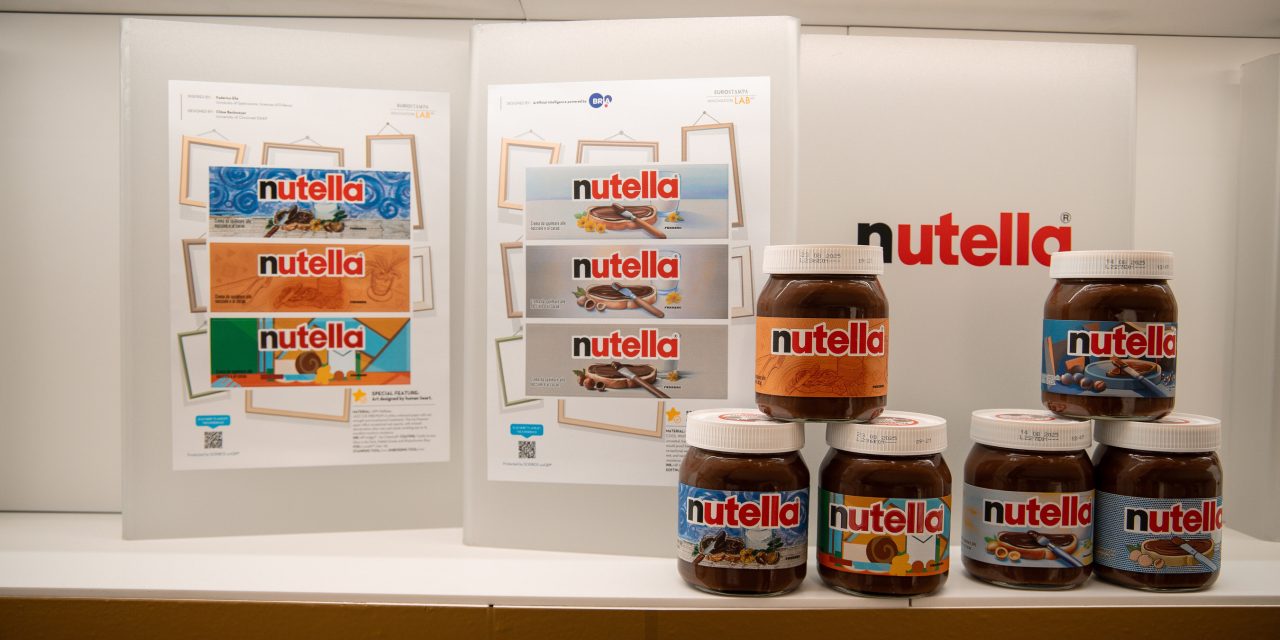
The Envelope project is an initiative where creative design challenges are met through collaborations between leading brands, technology providers, and students from top universities to push the boundaries of label design by experimenting with new and existing technologies, materials, and printing. The students challenged Bria and HP to reimagine Nutella®‘s iconic label through the lens of different art movements, including Cubism, Impressionism, Pop Art, and more with the goal of making each jar a unique artistic statement.
Eurostampa, renowned for its high-quality labels for wine, sparkling wine, spirits, chocolate, food and cosmetics packaging, has been collaborating for several years with students from the University of Gastronomic Sciences of Pollenzo, Italy and the DAAP (Design, Architecture, Art, and Planning) Program of the University of Cincinnati, Ohio. Its eighth iteration, Envelope 8, focused on harnessing AI to create unique Nutella® labels, pushing the boundaries of personalisation and artistic expression through technology.
As a pioneer in responsible generative visual AI, Bria distinguishes itself by using licensed content to train its models, ensuring responsible image generation with proper royalty attribution. Bria’s platform excels in producing customised visual content while maintaining strict compliance with copyright and privacy regulations, making it an ideal solution for brands seeking personalised, scalable design solutions.
The integration of Bria’s platform with HP SmartStream Designer’s ‘HP Spark’ technology enabled the creation of 9,000 unique Nutella® labels. This achievement demonstrates AI’s potential to transform the variable data printing industry. HP SmartStream Designer, a component of the PrintOS Creativity Power Pack, provides cutting-edge capabilities for variable data printing. The software enables designers to create unlimited variations of packaging designs and utilise ‘HP Spark’ for automated, AI-driven design generation, all while maintaining consistent quality across large-scale personalised printing runs.
The Envelope 8 project showcased these capabilities by seamlessly combining AI-generated designs with Eurostampa’s HP Indigo digital presses, demonstrating the sophisticated integration of creative AI and advanced printing technology.
“This collaboration represents a significant leap forward in the way leading brands can effectively utilise risk-free visual generative AI while simultaneously prioritising creativity and personalisation by ensuring predictability and controllability of the outcome,” says Dr. Yair Adato, Co-Founder and CEO of Bria. “By successfully merging visual gen AI applications with industrial printing capabilities, the project sets a new standard for both customised product packaging and the commercial use of visual gen AI as a whole.”
“This proof of concept for Nutella® exemplifies the transformative potential of combining gen-AI, design expertise, and digital printing technology,” says Joan Perez-Pericot, VP & Global Head of Software & Solutions at HP Industrial Print. “The project demonstrates how collaborative innovation can revolutionise personalised packaging, creating unique consumer experiences while maintaining brand consistency.”
“At Eurostampa, we are committed to fostering innovation and creativity through our partnerships. By involving students in real-world projects, we are advancing label design and providing valuable educational opportunities to ensure that our labels meet the expectations of Generation Z consumers,” says Riccardo Sauvaigne, Marketing and Innovation Director, Eurostampa.
What does 2025 have in store?
Whilst AR and AI integrated solutions are transforming packaging development, the packaging industry still has some key challenges to tackle. Regulatory pressures and sustainability goals are driving innovation in material efficiency, recyclability, and circularity, as emphasised by industry leaders below:
Lisa Cain, Technical Lead, Food and Confectionery – EMEA, at Smurfit Westrock says: “If there’s one thing driving the packaging industry in 2025, it’s regulation. The rules are coming in fast and getting tougher by the day. From stricter recyclability targets to material bans, it feels like every week brings a new challenge. It’s like aiming for a moving target—one that’s also shouting for us to ‘do better’!
“But honestly, that’s the point. Regulations are pushing us to leave the “that’ll do” mindset behind and finally deliver the kind of innovation we’ve been talking about for years. From lighter, more efficient materials to designs that make recycling seamless, the challenges ahead are opening the door to smarter, better solutions.
“Of course, this shift toward sustainability and minimalism isn’t without its headaches. Packaging minimisation requirements could make it harder for brands to create distinctive designs—unless those designs meet strict criteria or are protected by trademarks or design registrations. Meanwhile, the push to eliminate certain materials or switch to more sustainable alternatives demand a tricky balance between creativity, practicality, and compliance.
“But meeting consumer demands doesn’t stop at convenience. Brands also need to deliver recyclability without sacrificing performance. In food packaging, for example, barrier performance and moisture resistance are essential, which is why so much R&D is going into recyclable paperboard coatings. Fibre-based packaging is stepping up to compete with plastics, and it’s exciting to see how far this can go.
“2025 certainly feels like a tipping point for packaging. The big question isn’t whether we can keep up; it’s how far we can push things. Regulations aren’t the villain here—they’re the nudge we’ve needed to do better, faster, and more sustainably. And if we can turn these challenges into breakthroughs, this might just be the year we surprise ourselves.”
Steve Lister, Sustainability Consultant to Global Brands, Retailers & Partners says: “2025 is the year we move beyond recycling and circularity in print and packaging is the next big focus. 2025 is the year we break free from the cycle of waste, embracing circular design and materials in print and packaging. Recycling is just the beginning; the future lies in creating products designed for reuse and regeneration, ushering in a new era of sustainable innovation.”
Luke Wilson, Managing Director of FACER comments: “As we enter 2025, the UK’s folding carton packaging industry is navigating a highly complex landscape.
“The folding carton industry tends to be cyclical, and in any downturn of demand excess capacity presents itself in the system. With supply outstripping current demand, this tends to lead, in most cases, to a zero-sum game.
“There are a huge number of specialist SME players in the market which we believe will continue to consolidate before demand returns. Although when it does, those that are positioned in line with factors that will influence the future of packaging, stand to reap the rewards of a very large market full of potential.
“The influencing factors we foresee involve the continuation of sustainability focus, technological advancements (AI, digital, AR, smart integration), evolving consumer preferences and purchasing behaviours, and a shift in the supply chain buyer/seller dynamics.
“While challenges persist, including distractions such as EPR, which are only serving to confuse and slow growth, we remain optimistic about the industry’s resilience and its capacity to rebound by aligning with global sustainability goals, embracing creativity and cutting-edge technologies.”
Keith Ockenden, CEO Zeus Group muses: “As we step into 2025, our hope is to see renewed confidence in the UK economy, supported by clear and consistent guidance on tax and sustainability regulations. This clarity will empower businesses to innovate, adopt greener practices, and meet evolving consumer demands.
“In the print and packaging sector, we predict a continued rise in automation and AI-driven technologies, enabling smarter workflows and cost efficiencies. Sustainability will remain a core focus, with a shift toward recyclable and reusable packaging materials. Additionally, advancements in cloud integration and security will further transform how businesses manage and optimise their operations. These trends, combined with stable economic conditions, will drive growth and resilience across the industry.”
As the packaging industry hurtles into 2025, the fusion of augmented reality (AR), artificial intelligence (AI), and digital printing technologies is no longer just a trend—it’s a fundamental shift in how products are marketed, consumed, and experienced.
From creating bespoke designs to offering dynamic, interactive experiences, packaging has become a powerful tool for storytelling, consumer engagement, and sustainability. However, this evolution isn’t without its challenges. As brands embrace cutting-edge technology, they must also navigate regulatory pressures, material constraints, and the demand for greener, more efficient solutions.
Industry leaders agree: 2025 is the year of action. The focus is moving beyond recycling toward circularity, with smarter materials and minimalistic designs taking centre stage. Brands are being pushed to innovate faster, balance performance with eco-friendliness, and align with changing consumer expectations.
Editorial Contact:
Editor: Kiran Grewal kgrewal@kennedys.co.uk