
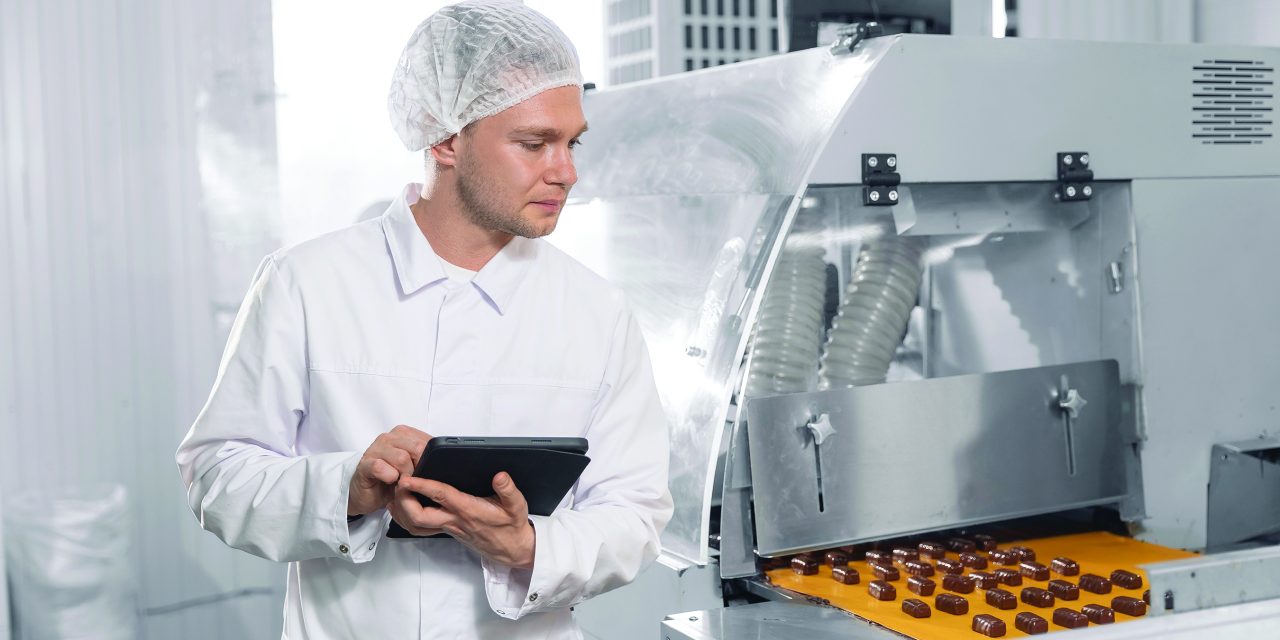
Artificial intelligence (AI) is affecting every part of our lives today. In confectionery manufacturing it is doing the same – finding applications in every area of a business, from marketing, product development, supply chain management and production. Suzanne Callander reports.
According to the Gitnux Market Data Report 2024, the adoption of AI in confectionery is expected to grow 25% annually over the next five years, supporting various parts of the confectionery business and consumer experience and becoming integral to strategies and operations – from marketing and formulation innovation through to customer service and supply chain management.
While artificial intelligence (AI) is being heralded by many as the next frontier of innovation – transforming everything from manufacturing to customer service – for many executives, especially those in traditional sectors like confectionery manufacturing, the return on investment (ROI) on any investment in AI remains a key question. Is it another fleeting technology fad, or does it present an opportunity to shape the future in the same way that the Internet has?
This question does carry some weight, according to Tastewise, a food and beverage consumer insights organisation that offers a Generative AI-powered consumer data platform. In a sector driven by complex supply chains, shifting consumer preferences, and the demand for operational efficiency, the stakes are high, it argued. Yet, avoiding AI might be more than a missed opportunity; it could mean falling behind. Businesses that ignore AI could see their competitors race ahead as they adopt AI to reshape their organisations.
AI has already begun to make its mark in our industry, optimising production lines, improving food safety protocols, and anticipating consumer trends. According to Tastewise, its true power lies in its ability to blend with existing processes, automating mundane tasks and enabling hyper-personalised products – all critical for a sector that must constantly balance efficiency with customer satisfaction.
Things like anticipating next year’s trends can mean the difference between thriving and surviving in a consumer-centric industry such as confectionery. Those taking early steps to adopt are setting themselves up for significant competitive advantages. In a world where consumers increasingly demand healthier, sustainable, and customised products, AI can facilitate fast and efficient pivots. This ability to respond to changes will separate industry leaders from those struggling to keep up.
So, while the fear of over-complicating operations or investing in a trend that might fade, is understandable, it is important to recognise that there are some confectionery manufacturers who are already seeing returns from AI.
Generative AI applications
Nestlé, for example, is deploying AI across nearly every aspect of its business to deliver increased value for consumers. While the company has been using AI as a business tool for many for years – often in behind-the-scenes roles like streamlining operations and driving supply chain efficiencies – recent advances in Generative AI have placed the technology top of mind and its use is set to increase exponentially.
“When I took on the role of Chief Digital and eCommerce Officer, Nestlé was already testing and learning with Gen-AI across several areas of the organisation,” says Veeral Shah. “I was excited that we had a jumpstart in exploring how the technology could help drive growth, solve business challenges, and ensure we continue to deliver for our consumers. Today, we have been moving quickly to deploy AI across nearly every aspect of the business. We quickly recognised its utility in working smarter and faster, enabling us to dial up our competitive intensity, and deliver increased value and relevance for consumers across our expansive portfolio.”
Putting people at the centre
Nestlé views AI as an enabler for its people. It is just one tool in a toolbox that is informed by the unique perspectives and experiences of team members. “As with any technology, we put our people at the centre of how we deploy it across our business,” says Veeral. The organisation launched NesGPT, an internal version of ChatGPT to equip employees with a tool to support productivity and decision-making in a secure, private environment. “We have provided training across our organisation to educate teams on how NesGPT can boost efficiency and help us work smarter, and it’s been incredible to see how our employees are leveraging the platform to support work across different functions like sales, product innovation, marketing and legal,” continued Veeral.
“One of our most exciting Generative AI projects is a new proprietary tool that is being used as part of the end-to-end product innovation process. The technology is anchored to consumer insights and plays a crucial role at the front-end of the process, helping teams generate and test product ideas in a faster and more efficient way,” says Veeral. The tool presents a range of concepts in a little over a minute, taking in inputs from more than 20 Nestlé USA brands and analysing real-time market trends to suggest creative product concepts that teams can then go on to explore and test. “We’ve already trained about 100 team members who make up Nestlé’s innovation community on how to use the tool within the innovation process and develop starter concepts by responding to just a few simple prompts.”
Marketing
AI is also driving many leading confectionery brands’ personalised marketing and interactive campaigns, with generative AI offering brands more opportunities to engage with shoppers and immerse them in their confectionery worlds.
Using generative AI for interactive campaigns allows brands to maximise creativity and connect with consumers in novel ways. For example, Starburst’s ‘Different Every Time’ campaign used generative AI to show consumers the 479 million ways to enjoy a 12-pack of original Starburst and Hershey’s custom AI campaign for Halloween combined sales data with increased advertising spending, which resulted in a boost in sales in targeted regions of 90%.
Improving productivity and quality
Integrating AI into existing processes and systems in confectionery manufacturing can enhance productivity, improve product quality, and optimise supply chain management. On the factory floor it can be applied in a wide range of applications, including predictive maintenance and quality control. AI algorithms can analyse equipment performance data to predict failures before they happen, helping minimise downtime and increase productivity. In quality control, computer vision systems powered by AI can identify defects in products more efficiently than manual inspection.
However, the integration of AI does present several challenges. One primary obstacle is the initial cost of implementation, which may require significant investment in hardware, software, and training. Additionally, many confectionery companies may face difficulties accessing or analysing the vast amounts of data required for AI systems to function effectively – legacy systems and outdated infrastructure can hinder smooth AI integration, creating compatibility issues.
To overcome these challenges, it is necessary to first identify areas where AI would have the most immediate impact – for example improving quality control or optimising production schedules. Gradually upgrading existing systems and adopting AI in incremental steps, rather than overhauling entire operations, can also reduce risk.
Starting small
Offering his advice, Keith Thornhill, Head of Food and Beverage at Siemens Digital Industries in the UK, argues the importance of starting with a small project before expanding the use of AI across operations. Confectionery manufacturing processes can be highly complex and often involving multiple stages, so this advice is good – pick one part of the process, demonstrate a good ROI and build from there. “AI is an exciting, transformative opportunity. But it’s vital to treat it as just one of the tools needed to achieve individual objectives, rather than as a solution for all outcomes,” says Keith.
On the factory floor the biggest strength of AI must surely lie in its ability to efficiently process and analyse huge volumes of data and every piece of equipment on the factory floor represents a potential goldmine of data – ranging from performance output and power consumption to operating temperature. AI can accurately monitor and interpret this data, identifying anomalies, patterns or predictive factors that only a very experienced human technician would see. It is important, therefore that any AI journey in the production environment starts by ensuring access to the right data, by acquiring detailed, accurate and diverse data that the AI system can learn from. An important first step is to invest in smart sensors and data acquisition systems to help capture the best data to feed into the AI system. There also needs to be a change in mindsets right across organisations, to embrace these new tools and harmonising them into daily work and processes.
A talking point
In 2025 AI looks to be getting even harder to ignore and it is expected to be a big talking point at the ProSweets Cologne 2025 exhibition too. From 2 to 5 February 2025, exhibitors will demonstrate their equipment and technology know-how for the sweets and snacks industry, with many presenting AI tools that offer a host of opportunities for increased efficiency.
The conference programme running alongside the event will also heavily feature discussions on AI, giving visitors an opportunity to hear about solutions and innovative approaches for the implementation of AI in production and the supply chain
Despite the proven benefits of AI, for many hesitations remain. However, much like in the early days of the Internet, delaying AI adoption poses significant risks and companies that wait too long could find themselves at a disadvantage. Their competitors are likely to be starting to use AI to help reduce production and supply chain costs which will put them in a better position to respond to market shifts more rapidly. With margins already thin in the confectionery sector, the cost of inaction is high – a loss of competitiveness, shrinking market share, and missed innovation opportunities.
Editorial contact:
Editor: Kiran Grewal kgrewal@kennedys.co.uk