
The confectionery industry is having to face the manifold challenges associated with improving sustainability in production – saving energy, improving yield, reducing waste, and reducing the carbon footprint of its processes – to help meet net zero goals. Every little step can help achieve these goals.
Efficient fluid management systems are an important consideration in a sustainability journey, and here pump systems have an important role to play. According to the British Pump Manufacturers’ Association (BPMA), pumps account for 10% of the world’s electricity consumption, and two-thirds of pumps use up to 60% more power than necessary, illustrating a need for optimisation in energy use.
Furthermore, a 2024 survey from the Food and Drink Federation (FDF), found that 30% of decision makers at UK food and beverage plants pointed to becoming more energy efficient as one of their top three growth priorities. At the same time, consumers are demanding products with lower carbon footprints, resulting in a need to deliver on sustainability targets while simultaneously keeping costs down.
Pumps are involved in many critical phases of confectionery production. “With such a wide variety of products needing to be pumped, viscosities vary extensively and can register in the thousands, or even millions of centipoise (cP). The pump chosen must be able to move the product quickly and efficiently, but also gently so as not to damage the foodstuff,” says Florian Walter, MasoSine Product Manager at Watson-Marlow Fluid Technology Solutions (WMFTS). “The more viscous a liquid is, the torque and hence power required to drive the pump rises, increasing energy use and cost.” Viscous liquids can also increase the pressure loss in the pipe system, which requires additional power to maintain the pump’s flow rate, increasing overall energy consumption.
According to the BPMA, an average of two-thirds of the electricity cost on industrial sites will be spent on running electric motors. Coupled with the fact that energy represents 95% of a pump’s life cycle cost (and over 80% of its carbon impact), substantial opportunities for reducing costs are clear.
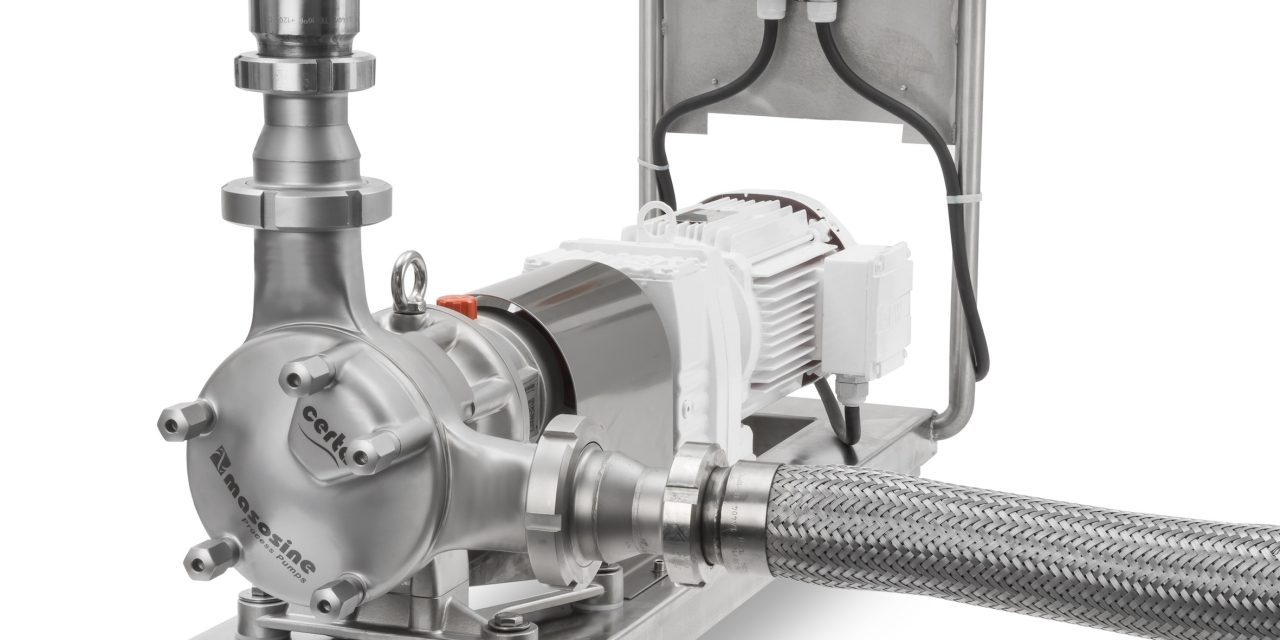
Sinusoidal pumps – which feature a sine-wave shaped rotor that creates four moving chambers within the pump – are said to require up to 50% less power than other pumping technologies for the same applications, especially when pumping viscous liquids. The rotor design enables handling of viscosities from 1cP to 8,000,000cP with minimal effect on power requirements, enabling even extremely viscous products to be pumped without a significant increase in energy consumption. “Sine pump rotors run with low shear, low pulsation and gentle handling without compromising on power, enabling fast processing without risk of product damage or waste. The ability to operate at a consistent flow rate saves energy and is gentle on system components, minimising system downtime and repair costs,” continues Florian.
Reducing waste
After experiencing damage to its chocolate and dried fruit mixture when using a screw pump system and then a diaphragm pump, French chocolatier, Cémoi moved to the use of a sinusoidal pump with heating element.
Cémoi had experienced damage to its chocolate and dried fruit mixture – including cranberries, hazelnuts, whole almonds. It found that up to 25% of the fruit was not delivered intact into the chocolate bars using the screw pump system. The sheared and shredded cranberries caused a build-up on the outside of the screw, leading to clogging issues, frequent production downtime and unacceptable product waste.
Cémoi initially replaced the screw pump system with a diaphragm pump but it experienced performance issues with this pump too, including an insufficient output and an even higher breakage rate of fragile fruit, approximately 30% higher than with the screw pump.
Cémoi needed to find a transfer solution that would provide the lowest shear possible. After doing some research, it chose a SPS 300 sine pump from MasoSine with heating element which provided all the features needed to gently and energy-efficiently handle the ingredients.
“We selected the sine pump based on its unique technology, a sinusoidal system with no mechanical parts, and a suction that does not alter the ingredients. We have not found any equivalent pump on the market that operates on this principle,” says Pascal Lhuissier, Maintenance and New Works Methods Technician at Cémoi.
Cémoi selected a MasoSine sine pump with a double envelope option which allows one part to be kept warm through water circulation. The process requires maintaining the pump at a temperature ranging from 40°C to 45°C, even when not running, to ensure the chocolate remains in a fluid state.
“Using this pump we have reduced the breakage rate of our cranberry and almond dark chocolate by three compared to the rate using a screw pump, and by four compared to a diaphragm pump. In the case of milk chocolate with hazelnuts, the breakage rate is reduced by 40% compared to a screw pump, while the diaphragm pump was not capable of transferring the product at all. The integrity of the product is maintained, and the almonds and hazelnuts, as well as the cranberries, remain whole. The appearance of the chocolate bar is also improved,” says Pascal. “The dosing of the ingredients is also more precise. From the start of production using the screw pump, both the speed settings and the time waste were responsible for producing recyclable material. Now, thanks to the sine pump, production starts up immediately, with virtually no loss of material.”
The pump also includes Clean-in-Place (CIP) and Steam-in-Place (SIP) features. It can be disassembled in just 15 minutes and reassembled just as quickly. Previously, the screw had to be transported to a cleaning room using a forklift at the chocolate maker.
Studies estimate that food and beverage manufacturing sites spend approximately 15-20% of working time on cleaning equipment and use around 10% of their energy in the CIP system, which itself can account for more than 15% of a company’s water consumption. So, optimising this process to minimise water consumption and reduce process downtime can help enable more sustainable production.
Editorial contact:
Editor: Kiran Grewal kgrewal@kennedys.co.uk