Suzanne Callander reports on the moulding and depositing solutions that are available today to help confectionery manufacturers keep up with fast changing consumer demands for every more innovative and unique offerings.
When most confectionery producers think about moulding equipment it is starch mogul systems that are most likely to spring to mind.
Early starch depositing solutions date back to the 1880s, when confectionery producers used semi-manual devices to streamline the approach of moulding liquid sugar-and-gelatine mixtures in trays of starch.
Over the years, the starch mogul process has undergone a series of innovations which has resulted in the automated systems we see today that are able to offer tray-handling, starch recycling and depositing technology, offering in fully integrated machine solutions that can load starch into trays, create impressions, deposit candy slurry, cover it with starch, stack and unstack trays and recover the candy.
“Moulding equipment plays a critical role in all starch mogul systems,” points out Morli Shah, Group Solution Specialist – Confectionery, TNA Solutions. “Today’s mogul systems are engineered specifically to produce a diverse range of confectionery products including gummies, jellies, marshmallows, fondant crèmes, aerated mass, centre-in-shell products, nutraceuticals and liquorice, and all of these products can be created on a single mogul system with variations in depositing pumps being able to create a wide variety of products in different shapes and sizes.”
Starch mogul machines have traditionally stood out for their ability to create intricate designs and visually striking features. This variety is achieved through the use of precision-engineered moulds, which are pressed into the starch bed to create cavities for the liquid confectionery mixture. It is the precision of the mould that ensures the final products are of a consistent shape, sizes and detail.
“We often talk to confectionery manufacturers who are facing challenges in achieving consistent and efficient production of starch-moulded products,” continues Morli. “Typically, problems stem from limitations in the existing moulding equipment or processes, which can impact both quality and output of the finished product.”
Offering a typical example, Morli pointed to a global confectionery brand which approached TNA to address inefficiencies in producing elaborate starch-moulded products. “The product in question is a single-layer gummy candy featuring six colours per tray and a mould shape with an intricate design of the product mass,” explains Morli. “After conducting a thorough audit of the existing processes, we were able to identify the root cause of their challenges. The company had been relying on in-house mould board manufacturing. While functional, this approach lacked the precision necessary to produce intricate designs and consistent product quality. The insufficient detailing on the rubber moulds resulted in variations in shape and precision, significantly impacting efficiency and overall production output.”
TNA proposed a solution that involved the introduction of precision-engineered metal moulds to replace the existing rubber ones. These metal moulds enabled the creation of highly intricate detailing, such as fine lines and complex designs, which were unattainable with the previously used rubber moulds. “By using advanced materials, including sturdy board frames and Teflon-coated metal moulds, the new system ensured durability, precision and superior product quality,” says Morli.
TNA also worked with the company to develop a specialised test rig to ensure that the metal moulds are printed in the starch bed with the highest precision, to help prevent defects and eliminate the risk of cross-contamination or colour bleeding between mould cavities. The modular design of the mould system also allowed for individual mould strips to be easily replaced if damaged, which helped reduce downtime and streamlined maintenance tasks.
The implementation of the precision mould board delivered significant improvements for the confectionery manufacturer. “Production output increased by 5% in terms of pieces per tray using the new layout at higher tray speeds. In addition, the tray speed increased to over 30 trays per minute. This enhanced efficiency and allowed the company to meet growing demand without compromising quality,” continues Morli.
“Defects – which had previously been a persistent issue – due to the limitations of rubber moulds, were reduced to nearly zero. The use of metal moulds improved product consistency, even for the intricate designs demanded in this application. This boosted product quality and also enhanced overall operational efficiency across production shifts.”
Optimising mould board design also simplified maintenance and reduced downtime, further enhancing production efficiency. Encouraged by these results, the confectionery manufacturer has since expressed its interest in extending similar optimisations to other product lines.
Mogul diversity
According to Winkler und Dünnebier Süßwarenmaschinen (WDS) the products created by mogul machines consist of far more than simple gummy bears, thanks to the ability of the technology to create diverse and complex products.
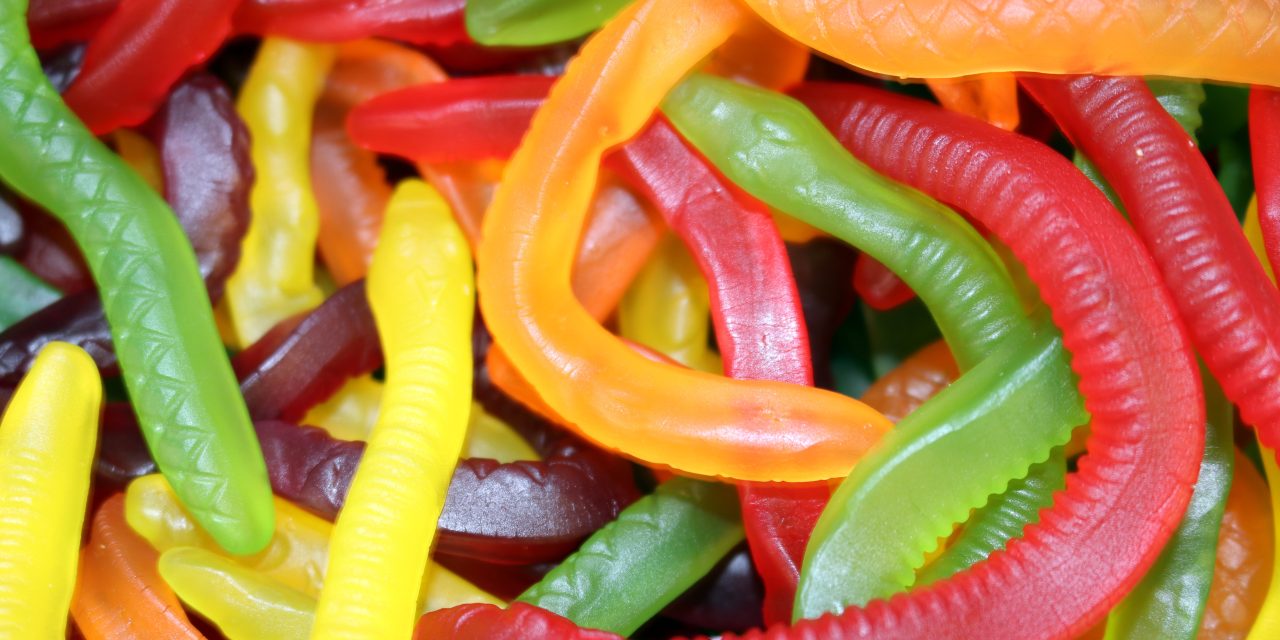
“Fruit gums with a wide variety of gelling agents can be produced on today’s mogul machines in a huge variety of shapes and colours,” says a WDS spokesperson. “They are mostly used to create single layered, one- or three-colour design products including gummy bears, worms and cola bottles. The two- or three-layer design is usually achieved by using consecutive positioned depositors and it is important that, in such applications, the sequence relates the specific weights of each layer which is why many layered fruit gums have foam layers on their back side.
The creation of products with a semi-liquid filling can be best achieved using a one-shot depositor which nests the two masses together with a concentric nozzle system and a piston control. A challenge here is that, if the liquid is slow to gel the filling could move from the centre at different densities of the masses. For this reason, the filling should be set slightly lighter than the shell mass. “After the one-shot depositing process, a foam cover can be deposited onto the product which prevents any further rise of the filling. In this way the core can be positioned in the centre of the product without exact weight settings,” continues the WDS spokesperson.
Pectin and agar jelly-based products are traditional in Eastern Europe. The region is also a strong market for fondants, toffee, and sweet foam products. Products produced for this region tend to be heavier than those produced for other regions of the world. They also tend to be coated in chocolate and so are often wrapped or packed individually.
With the type of products produced on a mogul in Eastern Europe differing significantly from what is produced in Western countries WDS has developed various technical solutions that make it possible to produce such confections with precision on fully automatically mogul lines.
Mogul plants for such applications, for example, need to be able to depowder the products in a regimented way. The filled product starch trays can be turned onto a wire mesh belt and lifted while the surrounding starch is removed completely via suction and blowing nozzles. While the products are cleaned of any starch, their arrangement is not changed, so the cleaned products can leave the mogul ready to be coated with chocolate, row by row.
WDS highlighted one interesting application that can be created using its the mogul technique – crusted pralines. The principle of crusted praline manufacture is that a sugar super-saturated, hot liquor solution is poured into hot starch and, as dehydration of the liquid starts to occur, the sugar begins to crystallise in the outer layers. In order to ensure uniform crystallisation, the starch trays need to be completely turned after a few hours. To achieve this WDS offers special turning devices. After completion of the crystallisation process, the products are carefully depowdered and are ready to be immediately coated with chocolate to create liqueur pralines.
Chip forming
IPCO used the recent ProSweets Exhibition to demonstrate its rotary drop depositor.
The latest model in the Rotoform range is the HP (High Performance) model, which has been developed to help increase productivity in chocolate chip forming.
The Rotoform solution consists of a heated stator and a perforated rotating shell that turns concentrically around the stator to deposit drops of chocolate onto a continuously running steel belt. A system of baffles and internal nozzles provides uniform pressure across the whole belt width, ensuring chips of uniform shape and size.
The circumferential speed of the depositor is synchronised with the speed of the belt to ensure that drops are deposited without deformation. The heat of the drops is transferred to cooling air blown onto the product and also to the belt itself. The short cooling time means that very little oxygen can penetrate the product.
Depositing demands
While the standard one-shot depositor has become commonplace on many chocolate manufacturing lines, it is important that they are precise and versatile enough to properly control the deposit profile and here servo control technology is a big help, enabling precise control of position, velocity, and acceleration through a feedback loop. Servo control can constantly adjust movement to ensure it reaches the desired location with a high degree of accuracy. “Using servo control on a chocolate depositor will enable the centre deposit to differ in velocity from the outer chocolate during the one-shot function,” explains John Micelli, Sales and Marketing Development at Egan Food Technology.
One confectionery trend that can challenge depositors is the demand for larger inclusions. “Many of our confectionery customers now require depositors that are able to handle ingredients such as whole nuts. It is important that the moulding line is able to properly meter these larger ingredients, mix them with other ingredients and then deliver the mix to the hopper in a way that the ingredients are distributed consistently prior to depositing,” he said. “We can offer an inclusion mixing system designed specially to achieve this, which can be mounted directly above the hopper.”
Another popular request identified by Egan Food Technologies is for a topper that is able to drops ingredients onto the back of freshly deposited chocolate, as well as depositing layers of colours or flavours – sometimes with a one-shot deposit on top of the first layer. “We are seeing much more creative use of decorator depositors, toppers and inclusion droppers to make ever more exciting and innovative finished chocolate products,” says John.
“Cold pressing chocolate shells is also becoming a more common request,” he says. “Confectionery manufacturers are looking to enclose large items completely in chocolate – such as whole cookies, other chocolates or even non-edible items like children’s toys.” Egan Food Technologies is able to achieve this with the ShellForm CHILL, which moulds instant chocolate shells ready for filling on a secondary process. Pairing this with a book moulding option allows confectioners to achieve unique finished products.
I asked John which type of confectionery projects he thought moulding might offer the best solution and when depositing might work best. His answer? “When you need a precise shape – whether for technical reasons or aesthetics – choose a chocolate moulding line. This ensures the product will fit its assigned packaging or take the shape of the mould of your choosing. Producing shapes such as bunnies, Santa’s, or engraved logos are a big draw for choosing moulding. Depositing without a mould will result in a less precise shape – such as a turtle or nut cluster – but it can expose portions of other ingredients in a manner that makes the finished product appear handmade. In either case, a quality depositor can deposit a very precise amount of chocolate to keep production consistent.”
“Having worked in chocolate my whole life, I have seen so many interesting, moulded chocolates – such as chocolate puzzle pieces, functional chocolate maze games, and even complex designs that use multiple decorator depositors dosing precise amounts of coloured chocolate,” says John. Egan Food Technologies has taken on some very interesting projects, and its moulding solutions have allowed confectionery manufacturers to select modular components that allow them to create unique products. “Examples include chocolate bars with a wafer and caramel layer inside; book-moulded, hollow chocolates with loose chocolate candies and marshmallows inside or even a capsule with a toy enclosed; and hollow chocolate characters filled with loose mini chocolate figures,” John concludes.
Depositing and moulding technology plays a crucial role in helping confectionery manufacturers meet rapidly changing market demands for unique shapes, premium quality, and consistent portion control. Whether producing chocolates, gummies, jellies, or filled confectionery, the use of precise modern depositors can help ensure uniform dosing of ingredients, which is vital for maintaining product consistency. By automating the dispensing process, modern equipment can also help improve production speeds and streamline workflow, ultimately lowering operational costs.
Among the most widely used depositing and moulding systems today are one-shot depositors, which accurately deposit chocolate and fillings in a single pass. Servo-driven depositors can offer enhanced control overflow and speed, allowing parameters to be rapidly adjusted when necessary.
Starch mogul lines remain a mainstay today for gummy and jelly confectionery, using starch trays to form moulds that deliver consistent and detailed shapes and textures.
With such a wide selection of technologies available today confectionery manufacturers should be able to find a solution that will help enhance product quality and enable them to introduce new varieties more rapidly, while also helping ensure efficiency across the production process.
Editorial contact:
Editor: Kiran Grewal kgrewal@kennedys.co.uk