Suzanne Callander gathers together advice and examples of how to ensure that the packaging matches consumer perceptions about premium products.
Packaging premiumisation can be a powerful tool in helping to define the perception of a premium brand. It should aim to engage multiple senses, enhance the visual appeal of the product and enrich the consumer experience. Getting it right can help elevate a product to a premium product and will help it stand out from the crowd.
Offering advice to confectionery brands looking to create a premium product, Clare McKeown, Sales Manager UK, Ireland and Nordic at Futamura, says: “Packaging plays an important role in helping a product stand out from the crowd and quality packaging are necessary to echo the quality of the product.
“Cellulosic films have been used for many years to achieve a premium product look within the confectionery sector. Futamura can offer a range of cellulose films in sparkling colours, as well as clear and metallised options to create attractive wrappers that can help differentiate individual flavours or brands.” According to Clare, these films are particularly well suited to small, twist wrap formats. “Not only do they create high end, jewel like packs, the films can also hold their twist naturally, without the need of heat sealing or adhesives. This means that the wraps can be easily opened, even by younger consumers.”
Clare believes that confectionery manufacturers are also searching for sustainable packaging for their brands today and Futamura’s NatureFlex celluloid films are created from renewable resources that can be composted at the end of life in a home compost bin, where the film will break down within 6 to 8 weeks. This offers a good sustainable option for small format flexible wrappings, such as twist wraps, which are otherwise impractical to effectively collect and recycle. “In the unfortunate event that a NatureFlex wrapper was littered, then it would still break down, ensuring it had a lower environmental impact than wrappers produced with conventional plastics,” points out Clare.
First impressions
Adding to the advice from Futamura, Richard Bell, Head of R&D Converting at Adapa, highlighted the fact that packaging is the first physical point of contact with the consumer and so the quality of a product will usually be judged by the look and feel of the packaging. “Packaging is especially important when it comes to impulse purchases, where premium/luxury look and feel can play an important role in consumer choice,” he says.
“Premiumisation of a product is typically achieved through the use of thicker/stiffer materials, glossy, matte or haptic lacquers as well as reduced and minimalistic designs and rich colours,” continues Richard. However, consideration also needs to be given to the goals of many governments to reduce product packaging resources – via recyclability or reusability – so many traditional premiumisation packaging solutions do need to be rethought. “We have already help several of our customers to translate iconic packaging traits into recyclable versions, helping to secure continuity of the future brand identity.”
Richard highlighted another possibility to ensure a product stands out from the crowd is to consider the use of stand-up pouches. “Because they stand upright on the shelf, they are easy to spot – a clear advantage in the competition for short attention spans. Pouches also offer the benefit of being resealable, helping to address portion control and keeping the product fresher for longer,” explains Richard.
He went on to point out that digital printing can also provide confectionery brands with a good tool for personalised packaging. “It can offer almost limitless possibilities and can actually customise every piece of packaging,” he says. “A clever way to individualise small packaging is to use printing cylinders with large circumferences and widths. In this way, many individual print images are applied with one rotation of the print cylinder. While the contours of the printing cylinder define the print images, the small size of twist packaging, for example, allows multiple customised graphics to be arranged on a single cylinder, resulting in a variety of designs.”
Sustainable solutions
Sustainability seems to be driving packaging innovation across all industry sectors, and confectionery is no exception. As consumer demand for more sustainable products grows, brands must adopt recyclable and renewable materials.
Melinda Bonamour, Market Development Director Paper at Coveris, highlights sustainability and personalisation as being key trends in confectionery packaging today. “In the world of confectionery, packaging is not just functional, it should also tell a story, evoke emotions, and enhance the indulgence experience,” she says. “Today’s consumers are also increasingly seeking products that don’t just spark their inspiration from a design point-of-view, but also align with their values of eco-consciousness, quality, and individuality, and we see these two areas as shaping trends in the future of confectionery packaging.”
For this reason, Coveris has placed sustainability at the core of its strategy, helping clients reduce their environmental impact across all packaging stages through its ‘No Waste’ approach. A prime example is its Premium MonoMaterial BBB Paper – a full-paper alternative to traditional Block Bottom Bags made of Paper/OPP laminates. This recyclable material is said to provide the strength needed for confectionery packaging, ensuring protection without compromising on environmental responsibility, as it can be disposed of with regular household wastepaper.
Melinda argued that confectionery packaging needs to balance sustainability with structural integrity. “The packaging must be able to protect delicate products like chocolates and candies during transportation and handling. Our solution combines sustainability with the durability required for premium packaging, ensuring that products remain intact while reducing their environmental footprint,” she says.
Premium packaging in the confectionery sector is often tied into gifting, making personalisation a key element in creating a memorable experience. Personalisation makes products feel special, enhancing the connection between consumer and brand. In line with Richard’s thoughts, Melinda also feels that digital printing has an important role to play, enabling brands to offer unique, customised packaging for special occasions, or individual consumers, at scale.
Beyond customisation, design and print quality are also important elements that help reflect the premium nature of a product. “High-quality, eye-catching packaging, combined with sustainable materials, creates a luxury experience that appeals to eco-conscious consumers,” continues Melinda.
Going one step further, she highlighted that great packaging goes beyond materials and design – it also thrives on collaboration. “We work closely with clients to develop tailored solutions that meet their needs,” she says. “This approach helps brands navigate the complexities of packaging and the ever-changing sustainability landscape, ensuring that products stand out while meeting growing consumer demands for eco-consciousness.
A premium pouch
The concept of bean-to-bar chocolate is the epitome of premiumisation, with artisan chocolatiers controlling all stages of their chocolate production – from selecting cocoa beans to creating the final product.
One such producer is Mikaël Portannier, who has created Texture chocolate – made from just cocoa beans and sugar. To elevate his chocolate bars, Mikaël needed packaging that combined practicality, aesthetics, and functionality. He wanted to avoid the common issues of traditional chocolate packaging, which can be difficult to reseal and is poorly suited for storage.
User experience was crucial when it came to deciding on the packaging for Texture. Mikaël explains: “Often traditional chocolate bar packaging can be difficult to fold, which spoils the consumer’s enjoyment. I wanted to find a simple but effective solution.” After evaluating several options, he chose to use a flat pouch with three side seals and a zip, supplied by ePac, rather than traditional foil packaging. This modern solution perfectly met his expectations. Further thanks to ePac’s low minimum order quantity Mikaël is able to order in small quantities, tailored to meet the needs of his emerging business.
Since launching Texture, the packaging designed by ePac has received enthusiastic feedback from consumers. Not only does it effectively protect the chocolate, but it also strengthens the brand’s visual identity with its elegant and professional design. Mikaël has also noticed improved customer retention due to this packaging. “Customers really appreciate the resealable zip, which preserves the freshness of the chocolate while making it easy to carry,” he says.
Holiday tips
Smurfit WestRock, a leader in sustainable packaging, offered some advice on packaging for seasonal confectionery. It suggested looking at paper-based packaging to make sure more packaging can be recycled. Paper is recovered at the highest rate compared to all other packaging substrates with over 83% of paper-based packaging is recovered for recycling in the EU, with over 65% of paper-based material being recovered for recycling in 2023 in the US.
Smurfit WestRock suggests confectionery brands consider the use of paper-based tubs for assortments of festive candy and chocolates which have traditional used plastic containers or metal tins. Recyclable, paper-based versions are now a viable option. Nestlé Quality Street holiday chocolate tub offers a good example of this. Traditionally, the tub was made from plastic, but for 2024, Nestlé worked with Smurfit WestRock to create a more sustainable paper-based version. Both versions of the tub were sold in stores through the holidays so that Nestle is able to run a consumer trial of the new packaging.
In 2022, around one-quarter of the world population planned to buy an Advent calendar, with the seasonal gifts being most popular in Belgium, Sweden and Italy. Many confectionery manufacturers create branded Advent calendars – with single-use plastic trays being the traditional way to package daily samples of chocolate. However, as brands look for ways to be more sustainable, calendars made from paperboard or corrugated cardboard are becoming more popular. Paperboard versions can be made in squares, rectangles or various holiday shapes, and perforated tear-outs can be turned into pop-ups to make the packaging more engaging.
Snow globe
Martin’s Chocolatier – an online retailer that provides luxury speciality chocolates from a wide range of internationally-renowned artisan chocolatiers – needed a unique snow globe type package that would be capable of holding a hollow chocolate Santa and snowball truffles in place, and which could be easily inverted by the consumer to dust icing sprinkles over the chocolates.
Philip Ahn, from Martin’s Chocolatier, explains more about the project: “Our vision for this product was an eye-catching pack design that not only made the perfect festive centrepiece but that could actually be used like a traditional glass snow globe, while maintaining the integrity of the chocolate contents. We approached Macpac, a UK-based thermoformed packaging manufacturer, after several failed prototypes from another company who was unable to create a pack that met the necessary strength requirements or was able to function as a snow globe.”
Macpac’s design team were able to develop a clear two-piece pack with robust domed lid that cliped to a separate base. The 100% recyclable snow globe was produced from recycled PET and incorporated a friction clip mechanism with added transparent self-adhesive security tabs.
Talking about the project, Neil Greenhalgh, Sales Engineer at Macpac says: “There were a number of design issues to overcome with this project. Part of the brief was for the forming to grip and hold the hollow chocolate mould tight enough that it could be turned upside down. Holding such a delicate item tight without damaging or crushing it was a challenge, which were rose to!”
“This meant that the holding of the Santa in position by his feet was literally touch and go but the team pulled out all the stops to get a design that matched the brief and we are delighted with the end result,” he concluded.
As the confectionery industry develops, packaging needs to adapt to meet new consumer expectations of luxury. Sustainability, premium materials, and personalisation are at the forefront of this transformation. By embracing these trends and fostering strong partnerships, brands can continue to delight consumers in today’s more environmentally-conscious market.
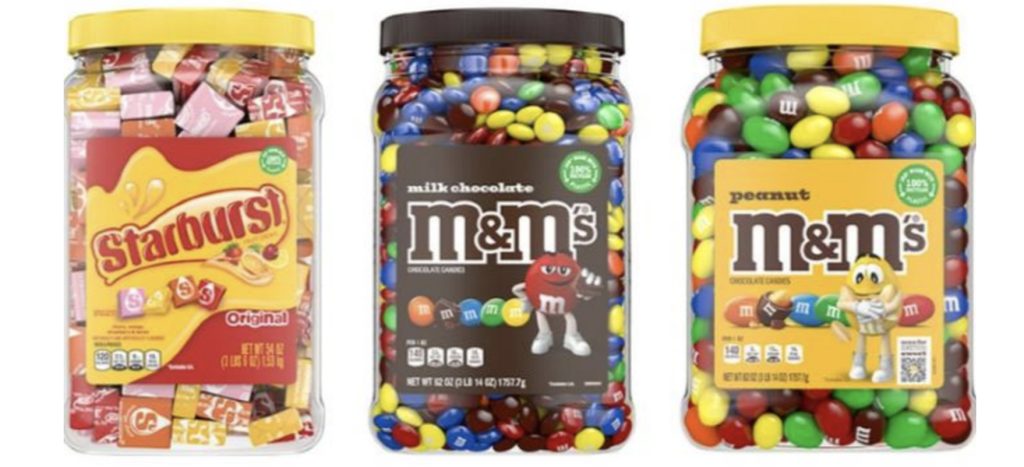
Mars pantry jars are now 100% recyclable
As part of its Sustainable Packaging Plan, Mars has been redesigning its packaging portfolio, in collaboration with Berry Global Group, to reduce plastic packaging and redesign packaging to ensure it can be reusable, recyclable or compostable.
The latest development has been the transition of its pantry jars for its M&M’s SKITTLES and STARBURST brands to 100% recycled plastic packaging, exclusive of jar lids. Berry and Mars developed packaging made with recycled content in a move that built on a previous launch in 2022 of the pantry jars with 15% recycled plastic. The updated jars are now rolling out across the US.
The pantry jars are now widely recyclable and it is hoped that this will eliminate more than 1,300 metric tons of virgin plastic annually. The easy-grip square jars use certified food-grade mechanically recycled resin sourced from curbside collection streams.
“In the world we want tomorrow, no packaging becomes waste, but is instead reused, recycled or composted,” says Allison Lin, Global Vice President of Packaging Sustainability at Mars. “That’s why we continue to rethink our approach to packaging and collaborate with companies like Berry. Reducing our virgin plastic usage by investing in recycled content is an important step in our strategy, alongside initiatives to remove unnecessary packaging, explore reuse models and redesign our packaging for circularity. Using recycled content incentivises increased collection systems and recycling infrastructure, which is essential for a circular economy.”