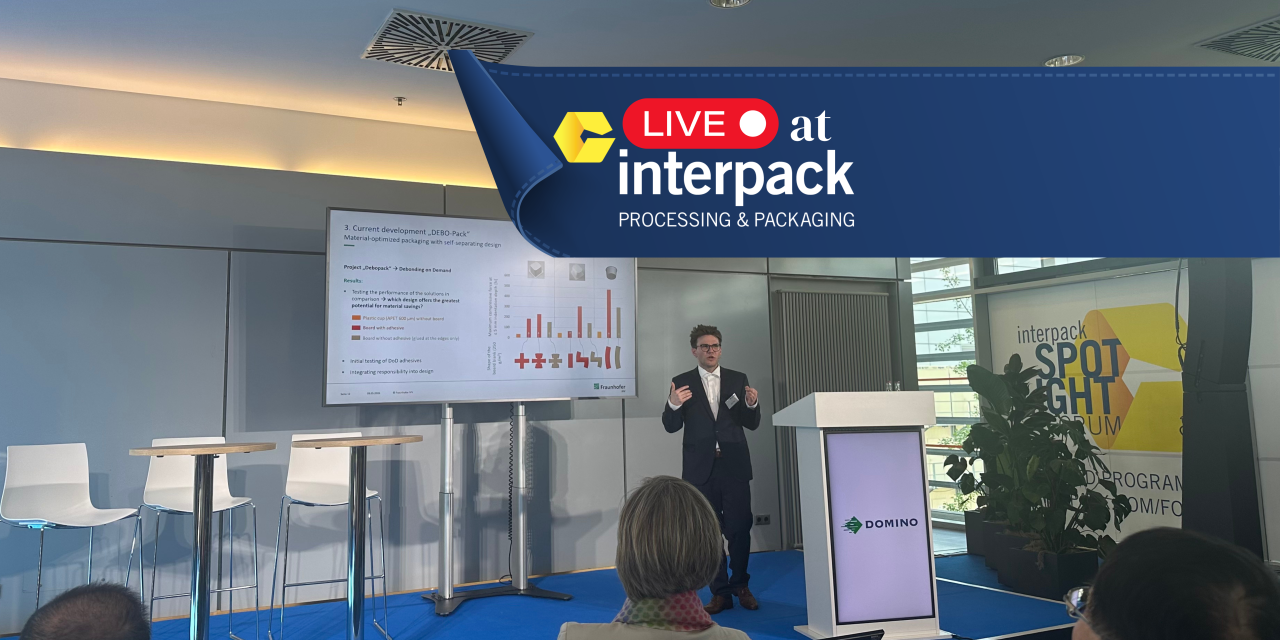
Reported live from interpack by Kennedy’s Confection, Jonas Peter explored how next-generation mono-material and autonomously separable hybrid packaging concepts could help manufacturers satisfy tightening recyclability criteria under PPWR and Germany’s VerpackG legislation without sacrificing functional performance.
At interpack’s SPOTLIGHT Forum, Jonas Peter of the Fraunhofer Institute for Process Engineering and Packaging IVV presented a technically detailed assessment of emerging packaging structures designed to reconcile high-performance functionality with increasingly stringent recyclability requirements under the EU’s Packaging and Packaging Waste Regulation (PPWR).
Speaking under the title “Sustainable packaging solutions are recyclable – without compromise”, Peter focused on the growing regulatory and technical pressure facing packaging developers as recyclability assessment criteria move away from theoretical design assumptions toward real-world material recovery performance.
Central to the presentation was the recyclability framework established under Germany’s Packaging Act (VerpackG), which specifies that packaging cannot be classified as recyclable based on the hypothetical dismantling of individual components after use. Instead, packaging systems must demonstrate practical compatibility with existing sorting and recycling infrastructures.
The requirement presents a significant challenge for complex multi-material packaging formats, particularly where functional performance depends upon combining fibre-based and polymer-based components.
“Sustainable packaging solutions are recyclable — without compromise,” Peter stated at the outset of the session, acknowledging the deliberately provocative nature of the claim before outlining a series of research projects intended to demonstrate its technical feasibility.
Throughout the presentation, Peter repeatedly returned to the increasingly critical interaction between material science, packaging machinery and regulatory compliance.
“In the future, machinery will move more into the background,” he argued. “The packaging is dictated more by innovative materials and optimised packaging design.”
The presentation framed PPWR not just as a legislative challenge, but more as a catalyst for fundamental packaging redesign. According to Peter, future packaging development will require closer integration between converting technologies, machine parameters, recyclability targets and end-of-life material recovery systems.
Particular emphasis was placed on mono-material packaging development and the reduction of unnecessary material complexity. Peter summarised the design philosophy succinctly: “Less packaging whenever possible, but paper whenever impossible.”
However, the session acknowledged that fully mono-material structures are not always technically viable, particularly where barrier properties, sealing performance or mechanical stability remain critical. In response, Fraunhofer IVV presented several hybrid packaging concepts intended to retain functional performance while improving recyclability outcomes.
Among the most notable developments discussed was “Bond on Demand” (BoD), a research project investigating autonomous material separation within hybrid packaging systems. The concept is designed to remove responsibility for material separation from the consumer by enabling packaging components to separate automatically during the recycling process.
“What if the mechanism is not in the hands of the consumer, but in the hands of the producer?” Peter asked.
Read the full report of this keynote in the upcoming May edition of Kennedy’s Confection. Subscribe here.