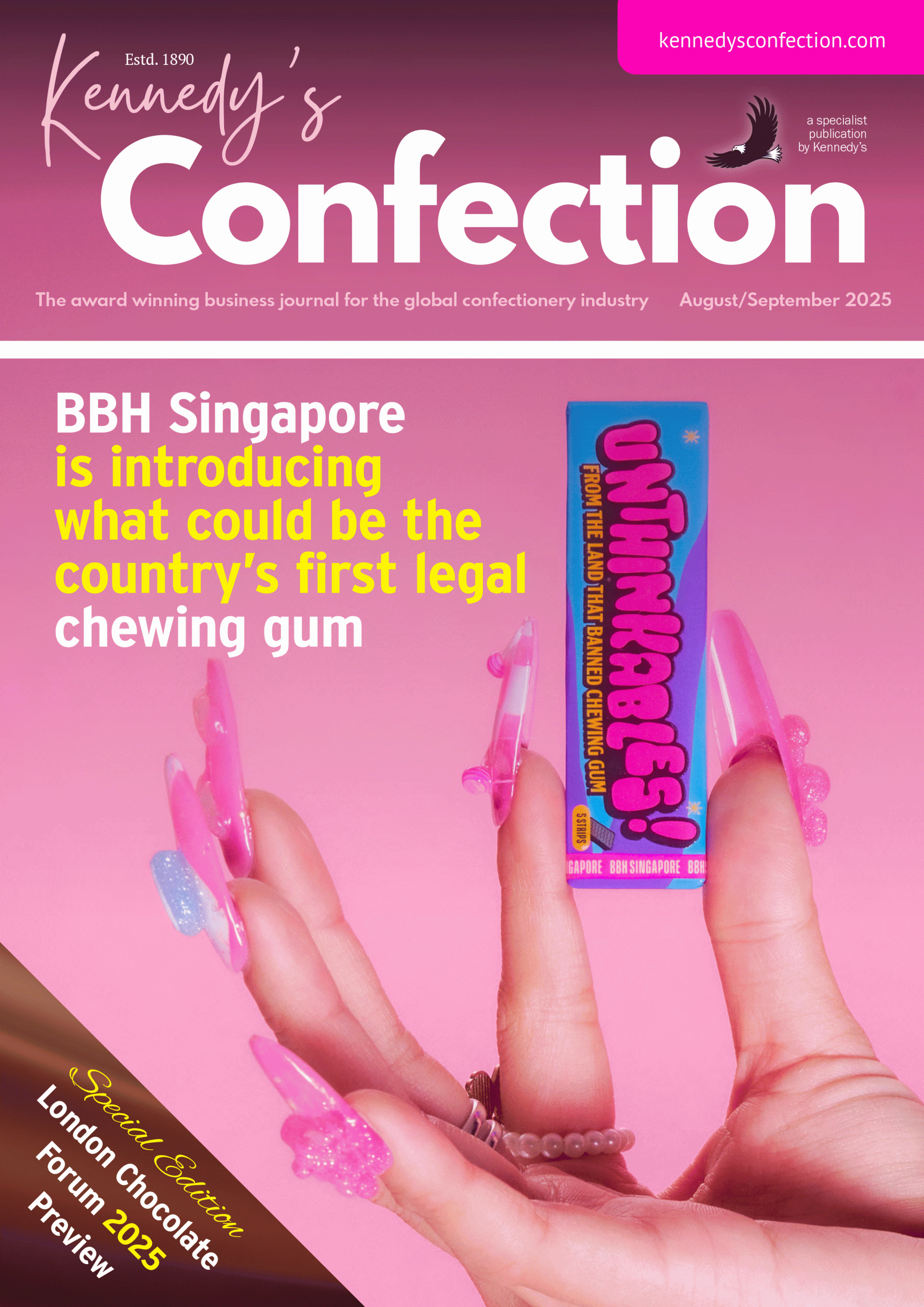
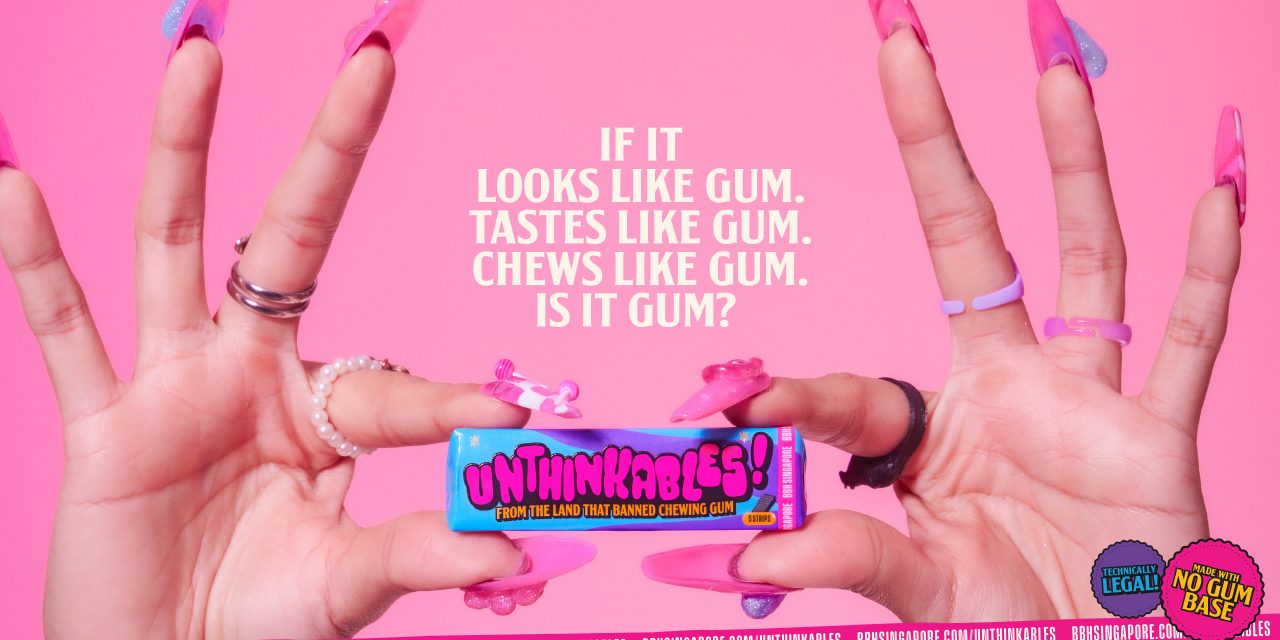
Chewing gum is famously banned in Singapore. So, to mark the nation’s 60th birthday, BBH Singapore is introducing what could be the country’s first legal chewing gum.
Called Unthinkables!, the “gum” looks, tastes, and chews like gum, but is made without a gum base. That technicality makes it legally permissible, giving Singaporeans the full gum-chewing experience without risking a fine.
The ‘gum’ was co-created with Irene Chan, sugarcrafter and founder of Oni Cupcakes, who worked with BBH’s in-house Innovation Lab to prototype the perfect chew. The team tried over 60 combinations of exotic flavours and chewiness-enhancing ingredients to arrive at the final product. Made from a hyper-chewy flavoured candy that’s fully water-soluble, the product sidesteps Singapore’s strict gum ban while making a statement about the agency’s appetite for impossible ideas.
Why is a creative agency making chewing gum?
Don’t worry, A.I. hasn’t left creative agencies seeking alternate business models. Unthinkables! is the agency’s showcase in disguise. Each unthinkable piece of gum comes with a printed QR code that links to an equally unthinkable piece of work from the agency’s portfolio. Such as Heinekicks, a viral and award-winning campaign for Heineken that turned sneakers into beer-filled art. Or Trapped, a full-fledged horror film created to launch a travel insurance for income.
BBH envisions the ‘gum’ as a way to spark conversations about the creative potential of Unthinkable ideas – ideas that make the impossible possible and tackle business problems with fame-driving solutions.
Sascha Kuntze, Chief Creative Officer at BBH Singapore, said: “It’s unthinkable to launch a chewing gum in Singapore. Just like it was unthinkable to design a puffer jacket for the tropics to launch an extra-refreshing beer. But that’s the point. Creativity lets us solve problems by making the impossible possible.”
Kennedy’s Confection’s Editor, Kiran Grewal, speaks exclusively to Natalie Shauna Tan (Junior Copywriter) and Jia Min Tan (Junior Art Director), to gain more insight about Unthinkables!
Developing a gum-like candy without a gum base is highly unconventional. From a formulation standpoint, what were the biggest technical hurdles?
Traditional chewing gum relies on a rubbery gum base to provide bounce, elasticity, and longevity. Remove that base, and you’re left with a confectionery puzzle: how do you create chewing gum without the actual gum?
The prototyping process took more than 60 rounds of experimentation. Some iterations captured the taste of gum but lacked chewiness, while others felt more gummy than truly chewy. A further complication was the form factor — the thin, rectangular shape meant we couldn’t rely on sheer volume to deliver a lasting chew.
At the same time, we needed to capture the visual look of gum. We were reverse-engineering a childhood memory, tricking the eater into feeling as though they were chewing real gum. That meant creating something that looked like gum, smelled like gum, tasted like gum, and, most importantly, chewed like gum, while still remaining fully soluble.
In the end, formulation became a delicate balancing act: a dance between classic candy flavours that evoked “gum,” a form factor that was unmistakably gum-like, and a mouthfeel that completed the illusion, even though it was, in reality, a hyper-chewy candy.
How did you balance the sensory expectations of traditional gum—flavour longevity, chew texture—with the constraints of Singapore’s gum regulations?
If there’s one thing everyone knows about Singapore, it’s that chewing gum is banned. The law was introduced in the 1990s as a way to curb littering and to stop vandals from jamming wads of gum into the automatic doors of subway carriages. We felt this iconic, if unusual, rule was the perfect canvas to demonstrate the power of creativity to solve any problem.
To truly tackle the challenge, we had to be uncompromising in recreating the sensory expectations of chewing gum as people know it. The look, the feel, the smell, the taste, and the chew all had to come together to make an instant impression.
What’s fascinating about the human mind is how good it is at completing an experience based on expectations and preconceived notions. No one actually knows what a “gum base” tastes like; they simply know that gum is chewy, sweet, and bursting with flavour. Add to that the rectangular shape of gum and the ritual of unwrapping each piece individually, and you get the complete sensory experience of gum.
In reality, the product contains no gum base at all. It’s a fully soluble candy that can be swallowed safely, yet it delivers the full gum-chewing experience. In doing so, we were able to craft something that both honours the spirit of the law and gives Singaporeans their long-denied gum fix.
The product underwent more than 60 prototype iterations. What key ingredient or process unlocked the final breakthrough?
We don’t want to spoil the magic too much, but we can say the process was as much about balancing flavour, texture, and colour as it was about maximising chewiness.
At one point, we experimented with exotic twists: an all-black “gum,” a version sprinkled with Pop Rocks, even a chilli-crab flavour (a cheeky nod to Singapore’s national dish). But we quickly realised that the further we strayed from what people instinctively associate with gum, the harder it became to convince them that it was gum.
Another critical part of the process was the shape and packaging. We tested a variety of forms and design directions, but ultimately, it wasn’t just about appearance. The ritual mattered: tearing open a pack, picking out a piece, unwrapping it, and even feeling the faint powdery coating on the strip; all of these small cues combined to make the experience believable.
Partnering with an artisan sugarcrafter like Irene Chan is unusual for a marketing agency. How did her confectionery expertise inform product innovation?
At BBH, we believe the best ideas are born from collaboration: none of us is as good as all of us. The right partner, artist, or craftsperson can make the difference between good and extraordinary. Working with Irene gave us exactly that edge. Her deep expertise in candy-making, paired with her instinct for innovation and fearless creativity, helped turn a bold idea into a truly exceptional product.
Flavour is critical in confectionery. How did you approach the flavour development process for a product that also had to make a creative statement?
We approached development with both rigour and playfulness. On one end, we tested the classics like mint or fruit, the flavours that instantly signal “gum” to most people. On the other, we pushed boundaries with wild exotic flavours – like chilli crab, durian, miracle berry and even chocolate.
The real magic, though, came from involving the entire agency. One of BBH’s strengths is the diversity of our people – different backgrounds, different cultures, different memories of gum. We turned everyone into beta tasters, gathering their instincts and reference points for what gum should taste like.
Through dozens of tastings (which no one complained about), we learned that the closer we stayed to the familiar “gum” spectrum, the easier it was for tasters to buy the story. That feedback ultimately guided us to the flavour profile that best recreated the authentic gum-chewing experience while still making a bold creative statement.
Unthinkables! is both a confectionery item and a brand communications tool. How do you measure its success in each of those roles?
At BBH, we thrive on hijacking cultural moments, sparking conversations that matter and giving brands a voice in stories already unfolding. This gum project has done exactly that: a playful provocation that captured attention, ignited debate, and showcased our commitment to work that can’t be ignored. More than just a creative stunt, it’s also a one-of-a-kind love letter to the city we call home.
Regulatory compliance is a major factor in food product development. How did you ensure full alignment with Singapore’s strict gum legislation?
The “gum” is made without a gum base and instead uses a hyper-chewy flavoured candy that’s fully water-soluble. It’s chewing gum without the chewing gum, a simulation of the experience.
From an industry perspective, what lessons can confectionery brands take from this case study about product-driven storytelling?
Product-driven storytelling is something we’ve always loved at BBH Singapore. In the past, we’ve created beer-filled sneakers as a smooth fashion statement for Heineken, and we’ve turned a virtual fruit into a real-world snack for Riot Games.
These kinds of products don’t just stand out from the competition; they give audiences fresh, memorable ways to connect with a brand’s message and point of view. Most of all, telling a story with a product is an unexpected zag. And zagging where the world zigs is at the heart of everything we do at BBH.
The QR code integration adds a digital engagement layer. How do you see such tech-meets-treat innovations evolving in the confectionery sector?
Tech-meets-treat innovations are opening up entirely new ways to engage audiences, with the potential to move from simple add-ons like QR codes to experiences that blend physical products with digital storytelling or gamification.
Looking ahead, do you envision adapting this formulation or concept for other markets with unique confectionery restrictions or cultural taboos?
Truth be told, this particular product is made for Singapore and only makes sense in Singapore, the country that banned chewing gum. You wouldn’t need a gum that isn’t actually gum anywhere else. However, we love the idea of creating a unique candy for every country in the world, playing on something unique and specific about that market or place.
So much of what we consume today is made to be generically universal, but something magical happens when you get hyperlocal and deeply specific, crafting something with a story tailored to the world it lives in.
With that being said, we’re always on the lookout for new partners, so drop us a line if you want to create something impossible to ignore!!
Editorial contact:
Editor: Kiran Grewal kgrewal@kennedys.co.uk