Suzanne Callander explores the growing interest in smart packaging technologies, and what they have to offer confectionery manufacturers.
A battle is raging in the confectionery world, according to Greg Brooks, Chief Marketing Officer at SharpEnd, a connected experience provider for business solutions. “On the one hand, there is more demand for dietary information on pack to help reduce obesity and there is a growing need to tell a story amidst increasing competition. And, on the other hand, there is increasing pressure to reduce packaging for environmental reasons.”
Greg pointed out that smart packaging allows for the creation of compelling and easy to read content about every ingredient in a product. Consumers are able to read this information in their own time and can use it to make better informed purchasing decisions.
“Rather than a basic traffic light system showing levels of fat, sugars, and salt and common allergens – with smart packaging brands are now able to go beyond this, covering far more detailed allergen information, as well as proper storytelling on the nutritional value of the ingredients and how they should be included as part of a healthy lifestyle,” he says. “This not only helps to align brands with regulations and planned initiatives – such as WHO and EU guidelines and the NHS 10 Year Plan – but, by adding traceability and sourcing information it is possible to prepare your brand for Digital Product Passports (DPPs) when they arrive for food items.”
Storytelling and promotions
Today, the confectionery market is more competitive than ever, with the top 10 companies in the industry only accounting for 37% of product launches globally – and with challenger brands popping up daily.
Greg cited brands like Tony’s Chocolonely as providing a great example of how storytelling can help drive sales, but with traditional marketing channels such as paid social and search becoming more expensive – there is now a lot of pressure on a small wrapper to tell a big story.
Smart packaging overcomes these challenges, enabling compelling experiences to be created, allowing consumers to explore a brand’s history through videos, or even take a virtual tour of a cocoa farm using augmented reality. And, if a brand is running a specific promotion, the information can change based on the product, time, or location if dynamic QR codes are employed on packaging.
No constraints
Whilst a confectionery product and its packaging will always be confined by its static, physical nature – smart packaging is not. By simply adding QR codes or NFC (Near Field Communication) tags on-pack – it is possible to direct the consumer to a pick and mix level of choices of dynamic content to solve a multitude of business problems.
NFC technology allows two devices to communicate wirelessly. The technology can be housed in a small chip that can be embedded into a packaging label to facilitate data transfer between nearby mobile phones, laptops, tablets, and other electronics. The benefit to confectionery manufacturers is manifold. NFC tags can be used to verify the authenticity of confectionery products, helping combat counterfeiting and protect brand reputation. The tags can also be used to track and trace confectionery products throughout the supply chain – from production to retail – and can transform packaging into an interactive experience, allowing consumers to access product information, promotions, and even loyalty programs with a simple tap of their smartphone.
NFC tags are also able to collect valuable data about consumer behaviour, such as which products are being scanned, where and when they are being scanned, and what information is being accessed. This data can be used to gain insights into consumer preferences, optimise marketing campaigns, and improve product development. Finally, NFC technology can also be used to help streamline internal operations, such as inventory management, quality control, and logistics.
The power of GS1
Going into more depth about the benefits of 2D barcodes, Nigel Allen, Marketing Manager 2D Codes at Domino Printing Sciences, explained that the main difference between 2D codes and linear barcodes is that 2D codes – such as QR codes – can hold significantly more data, and can also usually be read by smartphones without the use of a specialist app. “In addition to freeing up label space for more innovative packaging designs and consumer marketing material, brands using 2D codes can also make use of additional data capabilities,” he says.
A global standards organisation, GS1 has developed a new standard to help brands migrate from linear barcodes to QR codes powered by GS1. “While linear barcodes contain just a standard GSI product ID, also known as the GTIN, QR codes powered by GS1 hold additional GS1 identifiers such as product lot, batch, and serial numbers, which act as a link to digital content tailored to the exact product in your hand,” continues Nigel. While standard QR codes link to one static webpage, QR codes powered by GS1 are able to connect to multiple different web addresses depending on the device or application used to scan the code.” In this way, QR codes powered by GS1 can facilitate data sharing in everything from shipping and logistics to aftersales support, consumer marketing, and end-of-life management.
Data that facilitates the identification of products down to the batch level can provide significant benefits for brands – not least of these benefits is the ability to manage ingredient changes, product issues, and recalls more effectively and ensure that consumers are given the correct information for the product they have purchased.
Including batch information within a 2D code allows brands to update and adjust web content for each batch. This can help identify where issues have arisen that might cause problems further downstream, for example, suppliers linked to certain batches of products associated with an increase in returns and/or complaints that could indicate a problem with quality. Batch information contained within 2D codes can also be used to more effectively manage recalls by more easily tracing the information back to specific suppliers where an issue may have occurred and stopping sales of affected batches. The target webpage can also be updated to include a recall announcement – accessible not just to consumers but also to everyone involved within the product’s supply chain.
Nigel argued that GS1’s new standard offers almost limitless flexibility, allowing brands to create and use 2D codes according to their individual needs. In conclusion, he said: “As brands seek to enhance their supply chain visibility – both upstream and in the last mile – now is the time to start thinking about migrating from linear barcodes to QR codes powered by GS1.”
Connecting with consumers
Dave Protheroe, Group Designer at Invopak, works directly with customers to meet their labelling requirements, giving him some useful insights into changing priorities and the rise of smart packaging technologies. He says: “Traditionally, packaging has been about shelf appeal and regulatory compliance. Today that is still important, but now there is a third need – connection. Brands are using connected packaging technologies as a way to build a direct relationship with consumers, and QR codes are a simple, effective way to do that.”
Dave has seen a big increase in businesses using connected packaging in recent years. “Often, it is as simple as including a QR code on the packaging that consumers can scan with their smartphone to connect to the business online. QR codes act as a digital portal, so there is a huge opportunity for businesses to be creative,” he says.
Anyone remaining unconvinced should take another look at QR codes, which have quickly evolved from being a relatively unfamiliar technology with consumers, be becoming a widely understood and accepted one. Consumers are now very used to scanning codes for more information, and brands can use this technology to link packaging to digital campaigns, loyalty programs, real-time content, and even virtual realities.
However, Dave cautioned that execution is key, saying: “A QR code is only as good as the digital asset it connects to. There has to be a compelling reason to scan, and what the customer sees must reflect the quality and personality of the brand. If there is a disconnect, or the content doesn’t deliver value, then the opportunity is lost.”
The scope for connected packaging is broad, but one of the most significant is in allergen safety. According to a recent report from GlobalData (Food Packaging Industry Trends, Opportunities, Growth Analysis and Forecast to 2028), more than half of people with food allergies have had an allergic reaction from mislabelled or unclear food packaging in the UK, with 23% of those experiencing multiple reactions. Connective packaging allows customers to access detailed allergen information quickly and easily and can highlight any allergen warnings.
It is important not to lose sight of the fact that the packaging itself must also be fit-for-purpose. A damaged, unscannable QR code could lead to customer frustration, which is one of the reasons why Dave recommends In-Mould Labelling (IML). “With IML, the label is ‘baked-in’ to the packaging as part of the manufacturing process. It’s a high-resolution print that’s also extremely durable, so the QR code will not peel, scratch or fall off like a paper label could.”
Anti-counterfeiting measures
While counterfeiting has traditionally been thought of as only being a problem for more costly consumer products, there has been a steep rise of counterfeiting issues within the confectionery industry in recent years. Not only do brands risk losing out on the associated revenues of these fakes, but Greg highlighted that there can be significant brand damage when consumers realise they’ve been a victim of a scam. Research has found that 66% of consumers say they would stop buying from a brand if they discovered they had been sold a counterfeit version.
SharpEnd has helped a well-known luxury chocolate brand with this problem by implementing an authentication step – made possible using serialised QR codes and cryptographic NFC tags that cross referenced with the organisations Product Information Management (PIM) system. This helped protect both the brand, and consumer health.
Smart packaging in action
Several confectionery brands are already experimenting with intelligent packaging to enhance consumer engagement, provide transparency and improve accessibility.
Cadbury, for example, has used unique QR codes on its Milk Tray ‘Share the Love’ campaign to let gift-givers record personalised video messages for recipients, blending tradition with digital interaction. In a separate UK pilot, Mondelez added QR links to Cadbury, Oreo and Barny packs, directing shoppers to its ‘SnackingRight’ platform to receive sustainability updates, mindful snacking tips and local recycling advice.
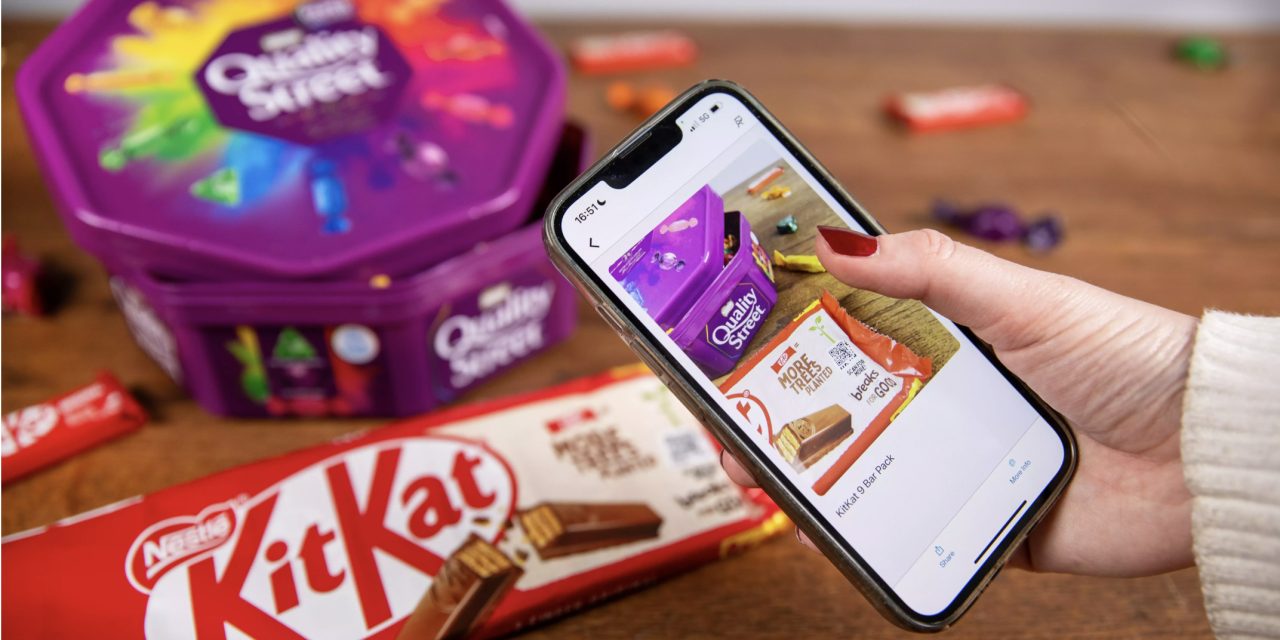
Nestlé has trialled enhanced QR codes on its KitKat and Quality Street brands to make product information accessible to blind and partially sighted consumers, while earlier KitKat campaigns linked codes to curated YouTube content for light-hearted brand engagement.
Hershey has embedded SmartLabel QR codes across products such as Kisses to provide extended ingredient, allergen and nutritional details, while Mars Wrigley took a creative approach with a Skittles Pride Pack, using QR to unlock an augmented-reality ‘World’s Biggest Rainbow’ experience and direct consumers to LGBTQ+ resources and donation opportunities.
Editorial contact:
Editor: Kiran Grewal kgrewal@kennedys.co.uk