

Tony’s Chocolonely brought together partners, brand ambassadors and mission allies to discuss sustainability and equity in the cocoa industry, focusing on resilience-building efforts, innovative solutions, and the importance of long-term relationships to drive systemic change. Kiran Grewal reports.
The second-ever Tony’s Chocolonely’s Open Chain event held at Tobacco Dock in London this month, and brought together a diverse group of stakeholders committed to fostering sustainability and equity within the cocoa industry. Participants engaged in insightful discussions, sharing key insights and initiatives aimed at addressing systemic challenges and driving positive change throughout the cocoa supply chain.
The event underscored the importance of resilience-building efforts not only for cocoa farmers but also across the entire supply chain. Tony’s Chocolonely aims to demonstrate the scalability of their model and its potential to make a significant impact on a broader scale.
Douglas Lamont kicked off the day and highlighted the persistent systemic issues in the chocolate industry, emphasising the necessity of collective action. The event emphasised the importance of acknowledging and tackling challenges such as child labour through collaborative efforts, under the tagline “Together, we’ll end exploitation in cocoa.”
Insights from Ghana
Honorable Ignatius Baffour Awuah, the Minister for Employment Labor Relations in Ghana, provided valuable insights into the multifaceted nature of child labour issues. He emphasised the need for collective action beyond singular supply chain focus, recognising that efforts should extend to other sectors like mining and fishing.
Honorable Ignatius Baffour Awuah highlighted the significant strides made in reducing child labour through educational interventions. He noted: “One major tool has been the deployment of education tools to reduce the incidence of child labour in our communities.” These efforts have drastically improved access to education, as he explained, “Before 2010, the average walking distance of a child to access a school was 4.7 kilometres. Now we have been able to reduce it to 1.2 kilometres.” This reduction means that “on average, within an area of 1.2 kilometres, you find a school located in every corner of Ghana,” ensuring that lack of proximity to a school is no longer a barrier to education.
He went on to explain how new initiatives have significantly reduced the number of children going without meals at school. Previously, students faced difficulties paying examination fees in their final year, but the government has now stepped in to address this issue. Additionally, they now supply school uniforms to students. These interventions are clearly making a positive impact, as primary education enrollment is steadily rising.
A change in legislation
Baroness Young of Hornsey OBE, gave a talk addressing the complexities of managing supply chains and the urgent need for the COPAD (Corporate Accountability for Human Rights and Environmental Due Diligence) legislation. She emphasised that it is the responsibility of businesses, not consumers, to ensure that their supply chains are free from human rights abuses and environmental harm. The talk went on to highlight the inadequacies of current legislation, such as the Modern Slavery Act, which has often resulted in superficial compliance rather than genuine due diligence. Baroness Young called for robust, preventative measures and greater transparency in supply chains, stressing that the UK must catch up with global efforts to legislate against unethical practices. The overarching message is that ethical sourcing should be a standard practice, ensuring that products are made without exploitation or environmental damage.
Baroness Young shared her discourse on supply chain complexities with a poignant admission: “It is difficult, and I’m not trying to underplay how complex it is.” She acknowledged the multifaceted challenges inherent in managing extended supply chains, stressing that addressing them is a collective responsibility: “That is the problem of all of you, and all of the people who run organisations.”
In her impassioned address, Baroness Young condemned the acceptance of unethical practices in certain regions: “it’s difficult to impose laws and legislation and policies…but again, that’s got to be done, you have to do that.” She urged stakeholders to confront uncomfortable truths, asserting, “you have to think about why it is that these things are happening in these particular places to those particular people.”
Baroness Young emphasised the need for rigorous due diligence, cautioning against superficial compliance: “this is not an exercise, it’s not about tick boxing. It’s about really rigorous due diligence.” She highlighted the potential for smaller organisations to excel in this regard, noting that they often possess a deeper understanding of their supply chains: “For a lot of smaller organisations, it’s easier to do because they know their supply chains.”
In her closing remarks, Baroness Young underscored the urgency of the COPAD bill, stating: “We’re not going to take two or 300 years to eliminate these practices…we know we can’t pretend we don’t know.” She called for decisive action, warning against complacency: “If we do, we do so at our peril, and we’d really be betraying not only those people over there, but ourselves too.”
European Deforestation Regulation (EUDR)
Renzo Verne discussed the implications of the EUDR on both companies and small farmers. He stressed the importance of traceability and advocated for radical transparency within the supply chain as key measures to address deforestation concerns.
Renzo Verne eloquently encapsulates the transformative impact of the EU’s No Deforestation Regulation on the Congo and the coffee, rubber, and soy sectors, describing it as a “massive shift” with profound implications for billion-dollar businesses and tens of millions of smallholder farmers. “One of the key elements in order to be in compliance with this legislation is having evidence to demonstrate that the supply chain is not linked to deforestation,” Verne highlighted. He emphasises the critical need for traceability and polygon information, noting that “it’s a complete rat race” as the conventional cocoa and chocolate industry scrambles to create this visibility.
Verne painted a vivid picture of the current scenario: “Hundreds of thousands of field officers are now mapping polygons around farms across West and East Africa, Southeast Asia, and Latin America,” all in an effort to position themselves for compliance. He contrasts this frantic rush with TOC’s long-term partnership approach, which embodies a deep level of traceability that has been meticulously developed and continually improved over time. “It’s really night and day in terms of preparation for this specific EUDR,” Verne observed.
The push for radical transparency doesn’t end with the EUDR. As Verne astutely predicts, “when all of this data starts getting uploaded into CPU portals, we can only imagine the types of questions that will start coming next.” The scrutiny will extend beyond deforestation to the conditions of production, including the treatment and payment of the farmers at the base of the supply chain.
In Verne’s view, investing in long-term partnerships with cooperatives is “a no-brainer.” He advocates for a business model grounded in transparency and partnership, as opposed to the opaque, transactional methods of the past. “That’s the way society is going, and that’s the way that business should be done,” Verne asserted, envisioning a future where sustainability and ethical practices are at the forefront of the global supply chain.
Sourcing principles and farmer resilience
Katie Sims, 5 Sourcing Principles Lead at Tony’s Chocolonely, emphasised the significance of long-term relationships as one of the core sourcing principles, explaining: “The reason that has been so important is that after five years, we start to see the long-term results coming through.” She elaborated that initial years with a cooperative involve setting up processes, resources, and support, but it is only after three to five years that the true impact of these efforts becomes visible. “It takes time to build up the skills, build up the awareness within communities, and then you start to see the impact of the five sourcing principles as a package,” she noted.
Katie acknowledged that while the program has seen successes, there is always room for improvement. She pointed out that this year has been particularly challenging for cocoa production due to climatic conditions, with cooperatives losing 25 to 30% of their cocoa. “We’ve been working on this for five years, but it’s clear we need to do more,” she said, emphasising the need for continuous review and innovation.
Katie highlighted several areas where the program is making strides and where there is potential for further development:
Emmanuel Ankama, Ghana Productivity Lead, shed light on the climate impacts in Ghana and highlighted Tony’s Chocolonely’s ongoing efforts to address pesticide management issues. Through initiatives like the CABI pilot project, the organisation seeks to empower farmers to manage pests effectively while reducing reliance on harmful chemicals. Katie shared the enthusiasm about the pilot projects in Ghana focusing on lower input and lower pesticide use, which promise to enhance climate resilience and boost farmers’ incomes. “The five sourcing principles is a package, and we always have to think about how each part impacts the other,” she remarked.
Katie shared findings on the amplified impact when combining different principles. For instance, the presence of a school canteen not only ensures children are well-fed but also increases school attendance. “When you see the data together, you really see that outsized impact and the potential that has,” she explained.
Katie concluded by stressing the importance of finding the right combinations of interventions to maximise impact. “We’re really looking for those winning combinations, how to make sure we’re bringing the right aspects of the five sourcing principles together to create impact,” she said. Continuous review and strategic investment in what works best are key to their approach.
Retail partnerships
Representatives from Waitrose shared their experiences and insights into their collaboration with Tony’s Chocolonely. The discussions highlighted the significant strides made towards addressing critical issues such as child labour, deforestation, and fair income for farmers, showcasing the impact and opportunities created by this partnership.
They acknowledged that Tony’s expertise in these areas has been invaluable, stating, “We are really delighted to be able to partner with them and hopefully benefit from that.”
The discussion highlighted the importance of open and honest communication about difficult issues. “Tony’s addresses these issues in a really open, honest, and accessible way,” a Waitrose representative noted, appreciating how this transparency resonates with customers who “love Tony’s just as much as we do.”
Natalie Rockell, Technical Manager at Waitrose, shared her inspirational visit to Amsterdam a year ago, which sparked their commitment to the Open Chain model. She recounted visiting cooperatives in Côte d’Ivoire, where the collaborative working relationships between cooperatives and farmers were particularly inspiring. “If I could take everybody there tomorrow, I would,” she said, reflecting on the positive impact of these relationships.
Rockell outlined three key takeaways from their experience over the past year:
Commitment and relationship building: The commitment to the model and investment in the professionalisation of cooperative members were evident during visits. The focus on productivity and quality, along with diversification efforts, highlighted the collaborative spirit between farmers and cooperatives.
Investment in education and infrastructure: Waitrose witnessed significant investments in education and infrastructure, such as building schools and hospitals. “Seeing the work that the cooperatives are doing, supporting and educating farmers, was just brilliant,” Rockell noted.
Supplier engagement: Engaging suppliers was crucial for the initiative’s success. “The value they added was so important,” Rockell emphasised, noting that even small changes in product sourcing could have significant impacts without altering the product itself.
Giles Fisher from Waitrose’s commercial team shared exciting numbers, highlighting the commercial success of the partnership. “The 72% dark chocolate bar is the third best seller in our range across the whole of Waitrose in chocolate,” he announced, noting a 16% increase in customer purchases compared to the previous year. He encouraged others to join the mission, stating, “If you’re thinking of doing it, go for it.”
Addressing the challenges faced, Fisher mentioned: “It was really hard work, but everyone, literally everyone up to James Bailey, who runs Waitrose, has been totally behind this.” The discussion acknowledged the complexity of contract negotiations and the need for long-term commitment, but also highlighted the support and dedication across the organisation.
The Tony’s Chocolonely’s Open Chain event provided a platform for collaborative efforts aimed at driving positive change within the cocoa industry. Witnessing the commitment of stakeholders from various sectors underscored the potential for meaningful impact and sustainable transformation. Moving forward, continued collaboration and concerted action will be essential in addressing systemic challenges and fostering a more equitable and sustainable cocoa supply chain.
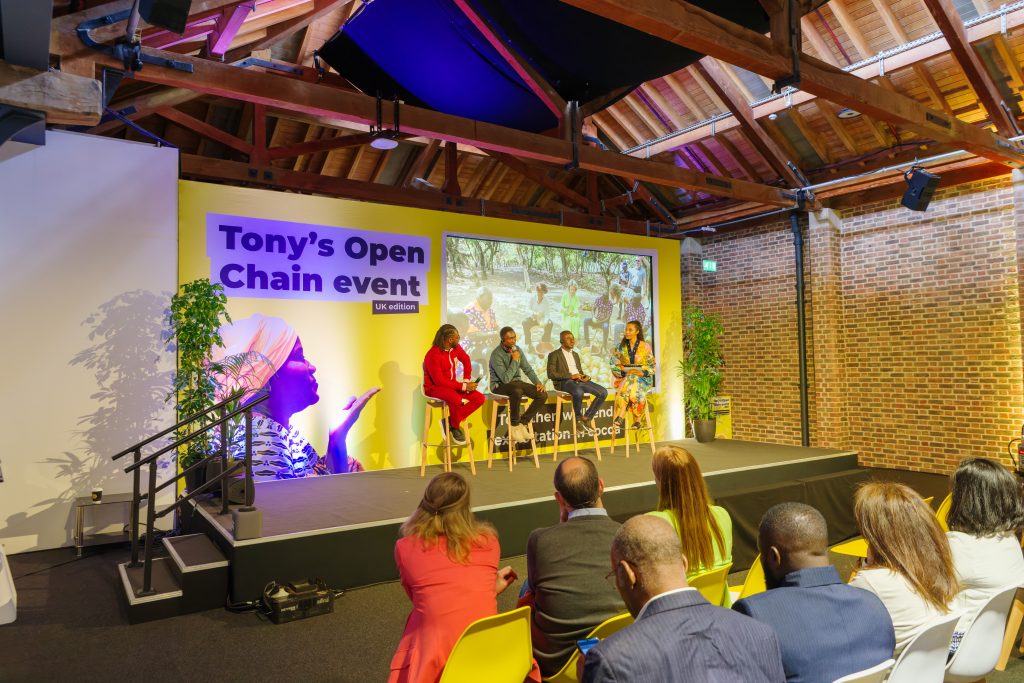
Image copyright: Nigel R Glasgow
Editorial contact:
Editor: Kiran Grewal kgrewal@kennedys.co.uk