Melinda Bonamour, Business Development Manager Paper at Coveris tells Kennedy’s Confection how lightweight recyclable materials are advancing confectionery packaging.
The challenge: when sustainability becomes mandatory
The confectionery industry is entering a new era – one where sustainability is no longer optional.
In 2026, manufacturers across Europe are facing growing pressure from evolving regulations such as the EU’s Packaging and Packaging Waste Regulation (PPWR), expanding Extended Producer Responsibility (EPR) schemes, and increasing packaging taxes. What was once a competitive advantage is now a baseline expectation.
At the heart of these changes lies a difficult balancing act between recyclability and performance, regulatory compliance and cost efficiency, and sustainability and production speed.
For paper packaging in particular, the bar is rising. To be compatible with standard recycling streams, materials must now meet strict 95/5 guidelines, meaning no more than 5% non-paper content by weight.
For confectionery brands – where packaging must protect delicate products like chocolates, candies, and lollipops while running efficiently on high-speed lines – this presents a significant challenge.
How do you reduce plastic, meet recyclability targets, and still deliver performance?
The solution: rethinking paper packaging
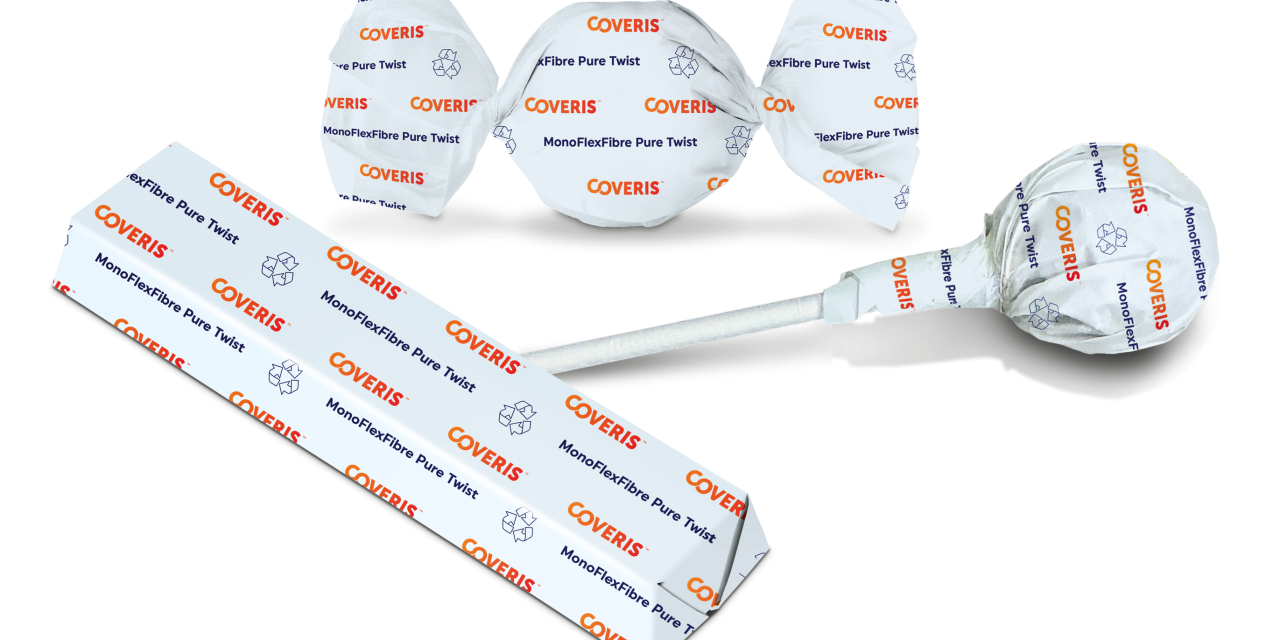
To address these challenges, Coveris has introduced MonoFlexFibre Pure Twist, a lightweight, recyclable, heat-sealable paper designed specifically for confectionery applications.
Rather than forcing brands to compromise, this innovation focuses on delivering balance across all critical requirements.
MonoFlexFibre Pure Twist replaces less sustainable materials commonly used for lollipops, hard candies, chocolate pralines, bars and sticks.
It achieves this through a single-layer, lightweight functional paper structure that meets 95/5 recyclability guidelines, reduces reliance on plastic and maintains reliable product protection
Why it matters: performance without trade-offs
One of the biggest barriers to adopting sustainable packaging is the fear of disrupting production. This is where the solution stands out.
1. Seamless Integration into Existing Operations
Transitioning to MonoFlexFibre Pure Twist does not require major machinery changes. It runs efficiently both on high-speed packing lines and standard FFS (Form-Fill-Seal) systems. This makes it a practical choice, not just a sustainable one.
2. Reliable Sealing for Confectionery Formats
The material supports single and double twist wrapping, as well as heat-seal flow wrapping, ensuring that product protection remains uncompromised.
3. Strong Shelf Appeal
With excellent compatibility for rotogravure, flexographic and digital printing, brands can maintain high-quality visuals while improving sustainability.
The bigger picture: preparing for 2030 and beyond
Regulatory changes are only going to intensify.
By 2030, all packaging placed on the EU market must be recyclable, with stricter, performance-based thresholds in place. At the same time, producers will face increased responsibility and cost for non-recyclable materials. This shift is redefining packaging strategy.
The transition to sustainable packaging doesn’t have to mean compromise.
Innovations like MonoFlexFibre Pure Twist show that it’s possible to meet evolving regulations, reduce plastic use, maintain operational efficiency and deliver high-quality packaging all within a single solution.
For confectionery brands navigating a rapidly changing landscape, the question is no longer if they should adapt but how quickly they can do it.
If you want to learn more, click here.