
Today, confectionery manufacturers need to balance the challenges associated with meeting rising demands, tighter margins, increasing product variety and growing expectations around quality and food safety. In response, many are looking at solutions that can help them achieve higher production speeds.
However, the relationship between speed and productivity has changed significantly in recent years, with advances in automation, digitalisation and connected manufacturing technologies helping confectionery producers achieve higher throughputs while maintaining greater control of their processes.
At the same time, developments in robotics, machine vision, product inspection and data analytics are enabling production equipment to operate more efficiently and with greater precision.
However, as confectionery manufacturers continue to pursue higher-speed, more flexible production, the real challenge is no longer speed alone – it is eliminating inefficiency while protecting product integrity and doing so quickly and precisely. A Schneider Electric global survey of Food and Beverage decision makers in April 2026 found that manufacturing delays and equipment downtime already account for over 20% of final product cost, creating a significant drag on both margins and sustainability. With these losses expected to rise further, the focus needs to shift from pure throughput to precision, synchronisation and intelligent control.
Because confectionery products are inherently sensitive to handling conditions – from mechanical stress and timing to environmental factors such as temperature and humidity – maintaining the right production conditions requires not just machine-level control, but the integration of facility systems and production processes within a unified digital environment. “At higher line speeds, even small inconsistencies can lead to deformation, breakage or waste,” warned Neil Smith, CPG President at Schneider Electric. “The solution lies in moving beyond traditional automation towards fully digitalised, data-driven and AI-enabled operations that can adapt in real time.”
Neil offered a powerful example – AI-augmented vision systems, which can detect even subtle product defects with high accuracy in real time, and at full line speed. “Through closed-loop feedback, these systems are able to automatically adjust the upstream processes such as handling and speed to reduce defect rates before they escalate. Crucially, this is not just about detecting issues. It is about continuously learning from production data and feeding insights back into the process.”
By connecting automation, electrification and true industrial intelligence within a single architecture, confectionery manufacturers can achieve end-to-end visibility and control across their production lines, which allows processes to be dynamically synchronised, ensuring that every stage – from forming to packaging – operates in harmony, preventing product collisions and minimising handling risk.
Neil went on to argue that data is one of the biggest untapped opportunities for confectionery manufacturers today – with estimates suggesting that up to 73% of industrial data currently goes unused. Leveraging this data through AI enables a shift from reactive quality control to predictive, self-optimising production which enables more consistent product quality, fewer false rejects, and significant reductions in waste.
“This reflects a broader shift away from chasing scale alone and towards precision manufacturing, where the focus is on producing the right product, at the right time, with minimal resource use. Industrial AI has an important role to play here, helping optimise yield, reduce energy consumption, and respond more effectively to changing demand patterns,” continued Neil. Ultimately, he argued that balancing speed with delicate handling should no longer be considered as a trade-off. “By combining connected automation, advanced motion control and AI-driven inspection within a unified digital framework, confectionery manufacturers can achieve both,” he said. The result is faster, more agile and more resilient production, delivering higher quality products with less waste and greater efficiency.
Cobots at the end of the line
Andrew Mason, Automation Sales Manager at RARUK Automation believes that one of the most effective ways to achieve a balance between throughput and product handling is through the use of collaborative robots (cobots) which are designed to combine precision, flexibility and controlled movement. He said: “Universal Robots cobots are widely used for end-of-line applications such as product packing and palletising, typically in non-high-care environments. One of our customers uses a Robotiq Palletising Solution, developed specifically for us, to palletise boxes of product. In this application, products are hand-packed into boxes before being conveyed through a case sealer, after which the cobot picks and places the boxes onto pallets. The cobot’s programmable motion ensures consistent, repeatable handling, reducing the risk of product damage.”
According to Andrew, a key advantage of cobots in this context is their ease of use and intuitive software, which enables rapid reprogramming and quick changeovers. This flexibility is essential in confectionery production, where there is often a requirement to switch between product types, formats or packaging styles without compromising line efficiency or handling quality.
“Technologies such as integrated vision systems enable the robot to detect and differentiate between product types or packaging formats. Vision-guided systems allow a single cobot to manage multiple product lines simultaneously – either from separate conveyors or mixed feeds – while maintaining accurate, gentle handling. This supports higher throughput and minimises manual intervention and potential handling errors,” said Andrew.
Cobots are also be deployed earlier in the process, particularly at the packing and labelling stages, where they can automate the picking and placement of packaged confectionery products into boxes with consistent force control, helping to avoid damage to delicate goods.
“Ultimately, by combining advanced robotics, vision systems and flexible programming, confectionery manufacturers can achieve faster, more efficient production without compromising on product integrity,” concluded Andrew.
Increasing production capacity
UK-based chocolatier Choc Affair has been able to achieve a significant increase in production capacity with support from Made Smarter Yorkshire and Humber. Made Smarter was created following a 2017 industry-led review into how UK manufacturing industries could prosper through the use of digital tools and innovation. Today this government-based partnership organisation is helps manufacturing SME’s to digitalise their processes to help increase productivity, reduce overheads, and a boost quality, capacity, and profits.
Prior to the investment in a high-tech labelling machine and the adoption of, the business was only able to label 600,000 bars per year, which was limiting its growth potential. Recognising the need to improve efficiency, Julian Barrie, Managing Director at Choc Affair, attended a York Manufacturing Roundtable event, where he met Mike Pennington, Business Relationship Manager at the York & North Yorkshire Growth Hub, which delivers the Made Smarter scheme locally.
Following engagement with Made Smarter, the company went through a digital transformation workshop process, which broke down its digital journey into quick iterative steps and created a roadmap of how to get there. This identified the digital tools and technologies that the organisation could implement to help it maximise operational processes and enhance growth. It also highlighted the skills that would be needed within the organisation to achieve its digitalisation goals. Based on the roadmap recommendations, the business was able to secure funding to invest in a new labelling machine which has increased labelling capacity to 1.5 million bars per year. This has led to faster turnaround times, reduced costs and improved competitiveness, without the need to recruit additional staff.
The adoption of this technology has also enabled Choc Affair to scale production within its existing site. The business estimates a 45% increase in turnover, while quicker response times are helping to strengthen customer relationships and encourage repeat business.
Balancing speed with gentle handling
When it comes to confectionery packaging, the key challenge is not simply to move products as fast as possible, but to keep the entire process under control. “With delicate products such as chocolate, pralines or soft confectionery, speed must be achieved through smooth, synchronised motion rather than through higher mechanical stress,” argued Markus Rustler, Managing Director at Theegarten-Pactec GmbH & Co. KG.
One important technology that is helping achieve this is continuous motion. “Unlike intermittent systems, continuous-motion machines can avoid repeated start-stop cycles. Product and packaging processes move in a constant, coordinated flow, which reduces acceleration and deceleration forces. This helps minimise deformation, breakage and surface damage, while also ensuring more stable product transfer throughout the line. For fragile or premium confectionery products, this controlled handling is essential for maintaining product quality at high output rates,” continued Markus.
In the past, continuous-motion systems were often associated with limited flexibility, as they were primarily designed for long, uniform production runs, making adjustments time-consuming and less convenient. However, this has changed considerably with new machine generations. The latest generation of continuous-motion machines can now offer significantly improved changeover concepts, enabling faster and more efficient adaptation to different formats and packaging styles.
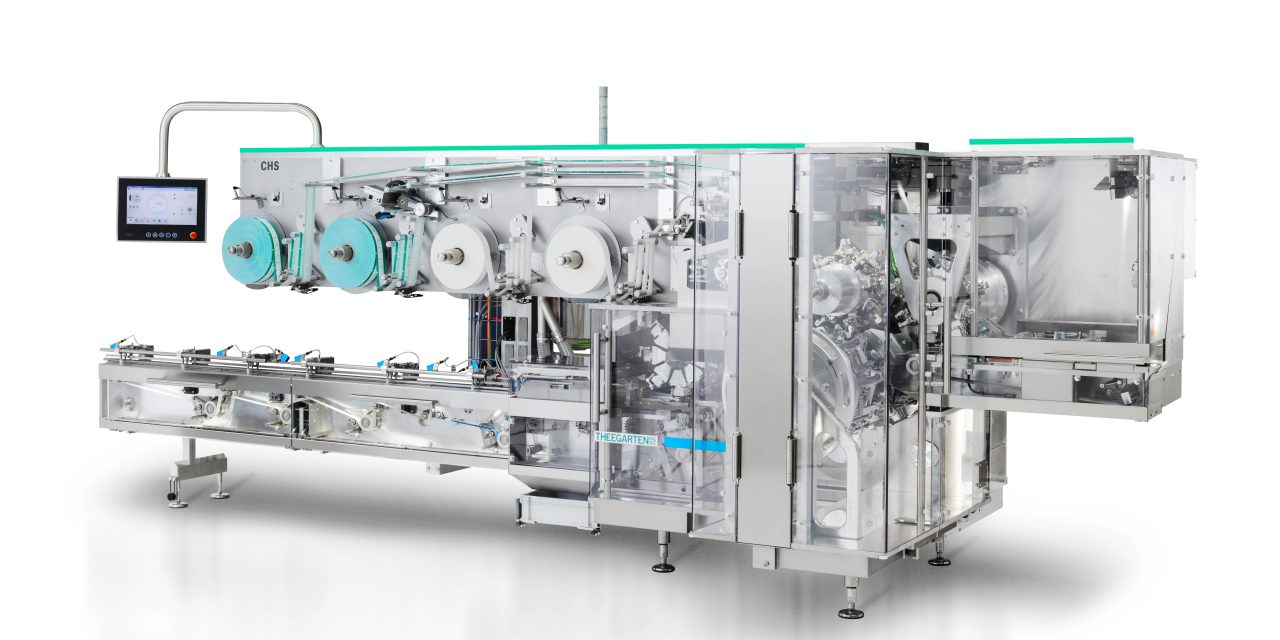
At Theegarten-Pactec, this approach is reflected in the modular CHS packaging machine which was developed for the gentle packaging of chocolate products and is able to reach outputs of up to 1,800 products per minute. Its modular design allows a range of ten different folding types to be implemented, including smart bunch, double twist, protected twist, top twist, side twist, foil wrap, envelope fold, bottom fold, side fold and Vienna-fruit-fold. Having this flexibility enables confectionery manufacturers to respond to seasonal products, shorter product life cycles and changing market requirements without compromising performance.
Markus pointed out that flexibility must not lead to complexity. “On the CHS, folding type and format changeovers can be completed in around four hours by a single operator. User guidance integrated into the machine and a lighting concept that highlights the relevant machine areas support a structured and reliable changeover process. This helps reduce downtime and ensures that high-speed production remains reproducible, even when different product or packaging formats are required. Required packaging formats can also be retrofitted, regardless of the machine’s original configuration at the time of delivery, allowing manufacturers to respond quickly to changing market requirements,” he said.
Besides flexibility of high-speed wrapping machines, Markus highlighted a new approach to machine operation – achieving efficiency independently of the operator’s level of experience. He said: “New machines such as Theegarten-Pactec’s flow wrapper FPC6 are designed to make machine operation largely independent of operator qualification and experience. The goal is to enable users to operate their systems independently, reliably and with a high degree of efficiency in times of skilled labour shortages.”
A key factor to enable this is improved identification of error causes and their effects. Enhanced visualisation on the touch panel and graphical guidance images can give operators targeted support for troubleshooting, even when the cause and the fault appear at different points in the process. The FPC6, for example, recognises when faults at the discharge section are caused by upstream process steps such as product synchronisation. In such cases, the control system specifically indicates possible root causes, reducing downtime and avoiding unnecessary interventions.
Overall, to ensure speed and product handling are properly balanced in the packaging hall, it is important to combine continuous, synchronised motion with flexible machine concepts, intelligent operator guidance, reproducible format changes and error-prevention technologies.
Maximising OEE
Matthias Drees, President at OKA, also highlighted the challenges of high-speed production when working with fragile and delicate products. “Confectionery items, such as hollow chocolate figures, aerated jellies, marshmallows, or brittle wafers, are extremely sensitive to acceleration forces, impact, and temperature fluctuations, so the challenge lies in maximising Overall Equipment Effectiveness (OEE) without driving up waste and reject rates due to product damage,” he said.
To maintain the delicate balance between maximum line speed and gentle handling, confectionery manufacturers are increasingly relying on advanced automation technologies in the packaging zone. At the same time, they are encountering upstream process parameters within the forming equipment that can present a new bottleneck.
Matthias believes that replacing traditional conveyor belts with linear-motor-driven shuttle systems can offer a solution. “With this technology, acceleration and deceleration curves can be mathematically tailored to the exact fragility of the product, virtually eliminating jerky movements during transitions,” he said. “Similarly, in pick-and-place applications, high-speed Delta robots are now being paired with advanced sensor technology. The implementation of soft grippers – engineered from flexible, food-safe silicone – or vacuum cups with integrated pressure regulators can effectively prevent surface marks, bruising, or cracking. Concurrently, high-speed 3D vision systems detect the exact orientation and geometry of the product within milliseconds, ensuring the robot calculates the optimal grip point without risk of collision.”
Meanwhile, back in the processing zone, throughput is still heavily governed by the physical process parameters. “A prime example of this is the highly aerated Angel Kiss, a product characterised by its exceptionally low density. Such delicate composition requires unique, dedicated forming equipment. “Innovation has brought us to the edge of physics. Today, the limit of high-speed processing and packaging is no longer the capability of our machines, but the integrity of the product itself,” continued Matthias. “While we have consistently pushed technological boundaries, pushing the process beyond a certain speed will cause such delicate masses to simply collapse.” This reality underscores the fact that higher packaging speeds remain fundamentally dependent on the stability of the upstream forming process and highlights the importance of considering total-line solutions – an approach that looks at the entire process from raw material handling through to final packaging. In this way high throughput and delicate handling are no longer mutually exclusive. “By strategically deploying targeted automation and respecting processing limits, it is possible to boost throughput while simultaneously reducing product waste – a crucial step to securing both premium product quality and long-term competitiveness,” concluded Matthias. “Although machinery engineering always aims to increase speeds and line efficiency, we are ultimately bound by the laws of physics governing raw materials and processing and the raw material’s physical matrix may still be the limiting factor when it comes to speed up process lines.”