
From sugar beet flour to intelligent ovens, the world’s leading bakery and confectionery fair spotlighted a sector in transformation. Kiran Grewal reports. The halls of Messe Düsseldorf opened for iba 2025 in May, the world’s leading trade fair for the baking and confectionery industry. This year’s iteration, drawing over 49,000 visitors from 149 countries, underscored not only the vibrancy but also the developing priorities of the global bakery and sweets sector, scalability, sustainability, and smarter manufacturing chief among them.
Across 100,000 square meters and nearly 1,000 exhibitors, innovation took centre stage. From AI-assisted production to clean-label cocoa alternatives, the breadth of technology and ingredient ingenuity on display provided a compelling snapshot of where the industry is heading.
Cocoa alternatives
Cargill, in conversation with Ellie van der Burg and Susen Gottwald on the stand with Kennedy’s Confection, highlighted Cargill’s strength in its extensive portfolio—spanning cocoa, chocolate, fats, and sweeteners—and in its capacity to offer targeted, scalable answers to shifting consumer expectations.
Of particular note was the introduction of Indulgence Redefined, a platform of sustainable, plant-based alternatives to cocoa, hazelnut, and peanut ingredients. Positioned as a solution for manufacturers balancing indulgence with environmental stewardship, the range leverages innovations in processing and ingredient sourcing to meet both flavour and sustainability benchmarks. Coupled with a significant capacity expansion at its Deventer facility, Cargill appears well poised to meet future demand without compromise.
Also challenging traditional cocoa narratives was Martin Braun Gruppe with its Win-Win platform, a suite of chocolate alternatives crafted to replicate the performance and sensory profile of traditional chocolate, while aligning with ethical and environmental goals. These bake-and freeze-stable solutions present a commercially viable path forward, particularly as price volatility and sourcing complexity continue to pressure cocoa supply chains.
The value proposition here is multifold: Win-Win not only reduces material costs and mitigates risk but also supports brand positioning around sustainability and responsible sourcing, an increasingly powerful lever in both B2B and consumer marketing.
-

- ChocViva from BAKO
-
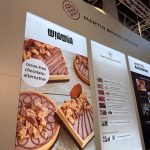
- Win-Win from Martin Braun Gruppe
Functionality and cost-efficiency intersected with sustainability in Th. Geyer Ingredients’ debut of cocoacut, an upcycled cocoa shell replacer. This clean-label, high-fibre ingredient serves as a 1:1 cocoa substitute, delivering authentic cocoa flavour and colour with less environmental impact.
The company also unveiled FOODSOLUTE® sugarcut, a 1:1 natural sugar replacement that maintains browning, texture, and sweetness, ideal for bakers seeking sugar reduction without formulation complexity. Together, these innovations respond directly to increasing demand for clean-label and reduced-sugar formulations, offering practical tools for formulators navigating regulatory and consumer-driven change.
Shelf life solutions
In a more technical application of innovation, Balchem presented its advanced encapsulation technologies, tailored to enhance shelf life, yield, and product integrity across bakery and confectionery categories. With over four decades of expertise, Balchem’s solutions address chemical stability challenges in complex formulations, allowing manufacturers to achieve more consistent, scalable results.
Such technologies are critical as the industry continues its push toward extended shelf life and greater global distribution, with consumer expectations for freshness and quality higher than ever.
AI in action
Perhaps the most tangible example of digital transformation came from AMF Bakery Systems in collaboration with QING, introducing STAQ, an AI-driven quality control system. STAQ “Sees, Thinks, and Acts” in real time, mimicking human decision-making to inspect baked goods by size, shape, and surface quality. By providing full coverage, defect detection, and trend analytics, STAQ enables bakeries to enhance consistency while reducing labour dependency, a timely solution as the sector contends with staffing shortages and rising operational costs.
AIPERIA, with its AI-powered store assistant that predicts in-store baking demand in real time. By optimising oven usage and reducing overproduction, the platform addresses both sustainability and operational efficiency, two of the retail sector’s most pressing challenges.
Integrated task management features further streamline workflows, making it a valuable tool for bakery and confectionery teams aiming to reduce waste while improving product availability.
Whether through plant-based innovations, advanced processing equipment, or AI-assisted production, the direction is unambiguous, toward a more sustainable, efficient, and technologically integrated future. As Roland Ermer, President of the German Bakers’ Confederation commented: “Exchange and dialogue are the driving forces of our industry.”
Dutch manufacturer Caotech demonstrated the continued relevance of mechanical excellence in confectionery. With live displays of its CHOCOCON 150 and CAO B5 lab ball mill refiner, the company highlighted scalable chocolate processing for both artisanal and industrial applications. Known for its self-developed ball mills and conches, Caotech offers end-to-end solutions for chocolate and compound production. The modularity and energy efficiency of its equipment underscore a broader theme across the fair: doing more with less, without sacrificing quality.
Moving on to the clean-label domain, KWS presented sugarbeet flour, a versatile ingredient with notable functional benefits, enhancing dough hydration, softness, and shelf life in bread, and offering a gluten-free, high-fibre base for cookies. Usable also as a natural sweetener, sugarbeet flour supports both nutritional claims and label transparency. This innovation aligns with the growing consumer preference for recognisable ingredients and “kitchen pantry” formulations, offering both performance and marketing appeal.
‘Art’ as the motto for the confectioners

Image courtesy of iba: Cup of Confectioners Award
The gold medal of The iba UIBC Cup of Confectioners goes to In Seok Kim and Kyung Joo Jang from Korea. At the world’s leading trade fair for bakery, confectionery and snacks, the participants presented world-class confectionery artistry. An expert jury judged the showpieces.
Chapeau and congratulations on this outstanding achievement! Confectionery Gold and the special ‘Best Showpiece’ prize go to Korea. The winning team of In Seok Kim and Kyung Joo Jang was announced on Thursday, 22 May 2025 at the iba.FORUM. The German team came second and Mexico third. The Jury President’s Creative Prize was awarded to Vasil Terziu and Bledian Ibrahimllari from Albania. All participants received a medal and a certificate.
Participants from five nations demonstrated world-class craftsmanship at The iba UIBC Cup of Confectioners at iba. In the show bakeries in Hall 14, the interested trade fair audience could follow how the best confectioners from Albania, Germany, Korea, Mexico and Vietnam produced and finished their sweet works of art. During the two competition days, the jury members Remy Corbet (Norway), Antonio Carlos Henriques (Brazil) and Marios Papadopoulos (Greece), chaired by René Klinkmüller (Germany), inspected and tasted the works.
The expert jury assessed appearance, flavour, variety and creativity. ‘My motto is: here and today are all winners at iba 2025! But only one can be the best. However, all those who have taken on these special challenges will improve as a result and end up with even more skills and expertise. This will advance them in other competitions and move forward their careers,’ emphasised René Klinkmüller, the jury’s chairman.
Over the course of two days, the talented confectioners created sweet creations following the competition’s motto ‘Art’. Their tasks: one showpiece made of sugar, brittle and chocolate and a matching glazed cake with at least three unbaked fillings. Further three different types of petit fours, three different pralines and two modelled figures had to be produced and last but not least, ten identical, motto-themed sweet pastries had to be manufactured. The requirement: all ingredients had to be edible and all decorative elements had to be produced on site.
Winner of the iba.START UP AWARD award
Fonte Ingredientes from Brazil received the iba.START UP AWARD at a ceremony on Wednesday, 21 May 2025. The public was invited to cast their votes online. Young companies presented their innovative ideas at the iba.START UP AREA in Hall 13.
The particularly creative and innovative masterminds for the baking industry have been selected: The iba.START UP AWARD was won by Diego Dominguez from Brazil with the start-up Fonte Ingredientes.
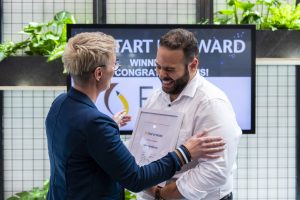
image courtesy of iba: Fonte Ingredients wins the iba. START-UP AWARD 2025
Trade fair director Susann Seidemann commented: ‘We congratulate Fonte Ingredientes. By awarding the iba.START UP AWARD, we are honouring innovative and creative ideas driving forward the international baking industry,’ emphasises Susann Seidemann, ’In particular we are delighted to support young companies with this award. The iba.START UP AREA was once again a genuine trade fair highlight for visitors and founders.’
Eight German and five international founders presented their creative solutions at the iba.START UP AREA. The spectrum ranged from apps, services and cocoa substitutes to ultrasonic technology in kitchen knives.
The Berlin-based company CupToYou has a portfolio of environmentally friendly paper cups made from certified materials. These cups are available in customised designs, even for small order quantities. To support enterprises in optimising quality and production, Enlyze, an industrial start-up from Cologne developed a combined hardware and software solution. Better cutting with ultrasound? The Czech company 369 sonic presented the world’s first kitchen knife with ultrasonic technology in the handle. A tech start-up from Aachen presented an app for a rapid ordering process: Snaggit eliminates waiting times and optimises processes thus increasing efficiency. Smart logistics with a system of stackable boxes and a lightweight trolley were exhibited by the German company Smox. The German agency Go German presented a service for recruiting skilled workers and trainees from South East Asia – including applicant selection, intensive courses and visa applications. Last but not least, the Swiss company ProSeed demonstrated how thanks to stabilisation technology brown barley byproducts can be used to generate barley flakes, which in turn can then be processed into flour or protein concentrate.
Some founders of iba 2023 exhibited again, such as WeCarry, the winner of the first iba.START UP AWARD in 2023, showing its deposit system for bakeries: reusable bread bags. Back also Peerox, a spin-off of the Fraunhofer Institute for Process Engineering and Packaging, presenting Maddox, a digital production assistant. Another second-timer was HY5 from Fürth with a sustainable, reusable glove made from organic cotton fabric.
These experienced founders talked in a panel discussion about their progress and further developments since the last iba in 2023, citing examples of best practice and encouraging people to try setting up their own business.
From groundbreaking AI systems to sustainable ingredient solutions, the industry’s evolution was on display and unmistakably underway.
Editorial contact:
Editor: Kiran Grewal kgrewal@kennedys.co.uk