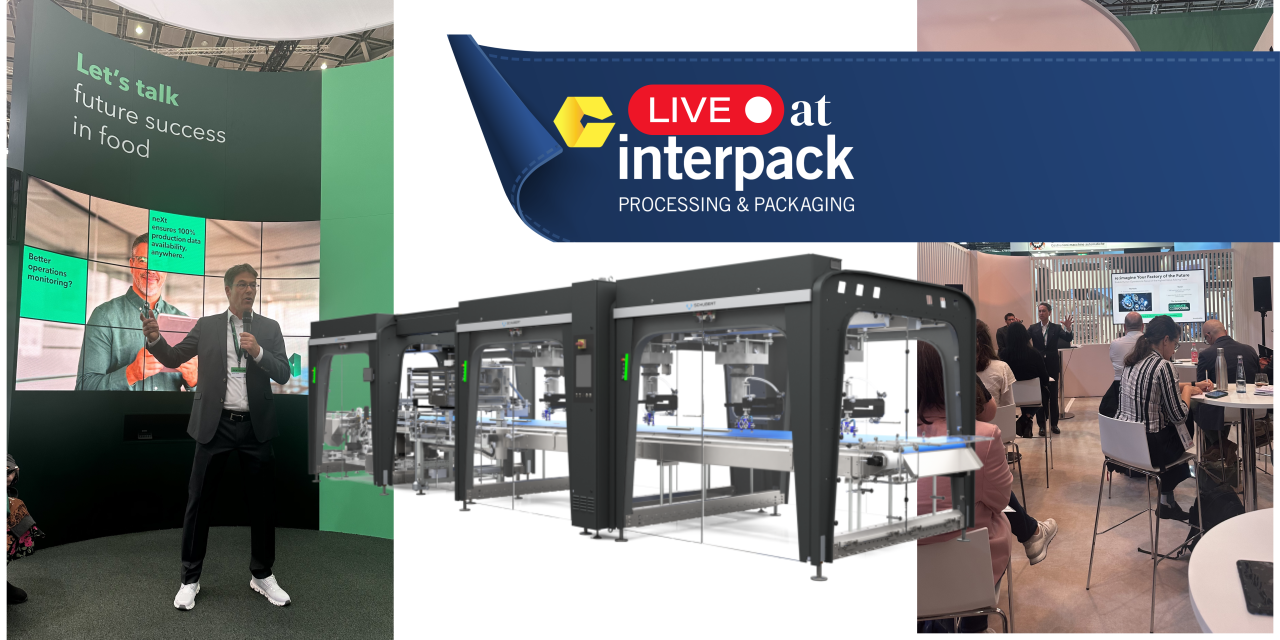
From an integrated frozen food line making its world debut, to a new “Factory of the Future” architecture, to advanced corner-seal bag capabilities for the SVX platform, Syntegon has arrived at interpack with a consistent message of seamless integration, automation, and operational efficiency are now the centre of the conversation.
Here’s what Kennedy’s Confection saw firsthand at an exclusive press conference:
One of the clearest themes running through Syntegon’s interpack presentation was integration. During the press conference, CEO Torsten Türling repeatedly emphasised that customers are no longer looking for isolated pieces of equipment, but synchronised systems that simplify production from end to end.
That thinking sits directly behind the launch of the new integrated frozen food line combining the SVX Agile and Elematic 4001 gravity case packer. “Customers don’t want to worry about interfaces or synchronisation between process steps. They want an integrated system,” Türling explained during the briefing. “If you have a fully integrated system instead of an assembly of single machines, you achieve the highest levels of automation and efficiency.”
That message was visible throughout the live demonstrations at the stand, where Syntegon showcased not only machine performance, but a fully connected operational philosophy: unified controls, shared HMI architecture, and seamless line management from primary through to secondary packaging.
Syntegon’s “Factory of the Future” takes shape with neXt
Beyond frozen foods, Syntegon also used interpack to officially unveil neXt, its new intelligent system architecture for food packaging operations. Rather than introducing another standalone machine series, neXt is designed as an operational ecosystem built around three pillars:
- Seamless Operation
- Smart Decisions
- Touchless Automation
The concept connects machines, AI-assisted monitoring, cloud-based analytics, automation systems, and autonomous material handling into one coordinated production environment. And unlike many “future factory” concepts that remain theoretical, Syntegon arrived with hardware already tied to the platform.
According to Türling, the scale of change happening across the food industry is forcing manufacturers to rethink how packaging lines operate. “Consumer tastes are changing faster than ever — different package styles, different retail formats, constant product variation,” he said at an opening speech to the press on the Syntegon stand at interpack. “At the same time, there is a shortage of skilled operators everywhere in the world.”
That combination, he argued, is driving demand for systems that are both more automated and dramatically easier to run: “You need automation, but at the same time you must make systems easier to operate.”
Two New Platforms Debut Inside the neXt Ecosystem
Two major machine launches anchored the neXt presentation:
HFX Flow Wrapper: A new modular primary packaging platform focused on flexibility, scalability, and automation compatibility.
TRX Topload Cartoner: A secondary packaging platform engineered for ultra-fast changeovers and reduced operator dependency.
One particularly notable detail from the TRX reveal: format changes can reportedly be completed in as little as ten minutes through guided or automated workflows. That’s significant in an industry struggling with labour shortages and increasingly complex SKU portfolios.
AI, Automation, and “Touchless” Packaging Operations
The most forward-looking portion of the presentation focused on autonomous production support.
Syntegon demonstrated how neXt integrates:
- AI-assisted quality monitoring
- Camera-based inspection systems
- Cloud-connected production analytics via Synexio
- Autonomous mobile robots (AMRs)
- Automated reel and carton blank supply systems
The company’s goal is to minimise manual intervention while enabling packaging lines to operate continuously for extended periods. In practice, that means operators shift away from repetitive machine handling and toward higher-level production oversight. Türling stressed that Syntegon’s focus is not simply adding more robots to packaging lines: “For us, smart automation is not about maximising the number of robots in a machine,” he said. “We try to achieve the highest performance with the lowest necessary number of robots.”
“The precision of the SVX allows the use of significantly thinner film material,” Türling said. “If you can reduce film thickness by half, you reduce material consumption by 50 percent. That is massive.”
SVX Gets a Premium Packaging Upgrade
Another major announcement at the press event centred on the evolution of the SVX platform itself. Syntegon revealed a new corner-seal capability for the SVX Agile, expanding the machine’s bag-style portfolio to include:
- Corner-sealed block-bottom bags
- Full Corner styles
- Doypack-style configurations
For confectionery brands especially, this is a strategic addition. Premium shelf-ready bag styles continue gaining momentum across candy, snacks, and bakery products because they improve shelf presence and product stability. But historically, these formats have been difficult to run at high speed with consistent seal quality.
Syntegon claims the upgraded SVX can produce corner-seal applications at up to 120 bags per minute — a major performance benchmark in this category.
What makes the new SVX configuration particularly interesting is the amount of automation built into process stability. The machine now incorporates:
- Automatic axial adjustment for film reel positioning
- Advanced web tracking for corner-seal alignment
- Guided format-change assistance
- Improved operator accessibility
According to Syntegon, these systems dramatically reduce the need for operator intervention after reel changes — historically one of the biggest pain points in corner-seal production. The company also highlighted sustainability benefits, emphasising improved mono-material processing and reduced material waste during setup and commissioning. “The precision of the SVX allows the use of significantly thinner film material,” Türling said. “If you can reduce film thickness by half, you reduce material consumption by 50 percent. That is massive.”
That aligns closely with the broader sustainability themes dominating interpack 2026, particularly around PPWR readiness and packaging material reduction, which Kennedy’s Confection will report directly from the PPWR keynotes in interpack SPOTLIGHT soon.
Read the full review in the upcoming May edition of Kennedy’s Confection. Subscribe here.