
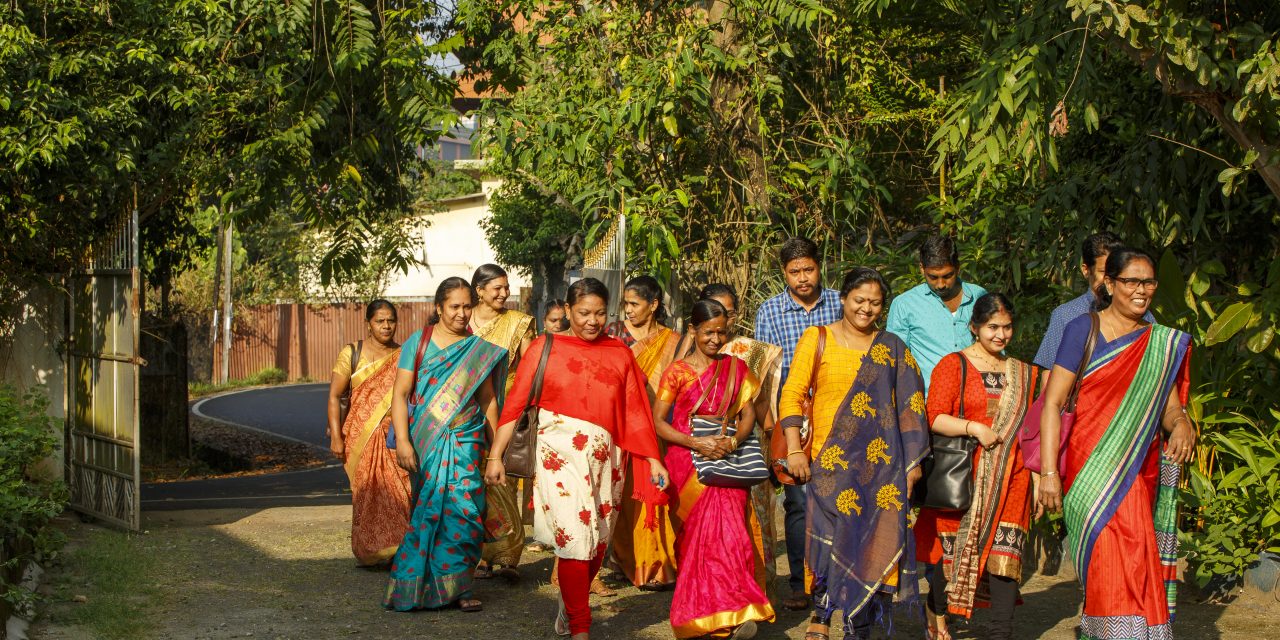
Kiran Grewal sits down with Gouri Kubair, Managing Director of Holy Lama Naturals to discuss her inspiring pursuit to bring global natural flavours to chocolatiers whilst also endeavouring to support and equip disadvantaged Indian women with independence, financial stability and transferrable skills.

Give us some background on Holy Lama Naturals and its mission statement.
Our Mission Statement is: Bringing innovative, natural products that excite and inspire people, and create social impact.
This sums up exactly what the Holy Lama Naturals business is all about. The story begins in the 1940s and spans three generations of my family. In 1948 my grandfather migrated from near Goa to Kerala, South India, to become a pioneer in the essential oils industry. He was the first person to cultivate vetivert (a tall grass) to extract the oils on a commercial basis and it’s from here that the beginnings of my family business, distilling and using essential oils in perfumery, can be traced.
Following in his father’s footsteps, my father, Vijay became involved in the family business at a very young age. His fascination with the world of essential oils and perfumery took him to Bhutan on a government-backed project helping locals cultivate and extract lemongrass oil.
During the 1980s, he lived in the Himalayas for eight years. During that time, he made a 12-day walking pilgrimage to Aja Ney where the presiding Lama presented him with a ‘Thangkha of Lama Guru’ which symbolises good luck in life. This is the inspiration behind the brand name – Holy Lama Naturals.
Over the 2000s the Holy Lama Naturals business went from strength to strength. My parents used their expertise in the distillation of essential oils and our family’s unique extraction process, to develop our range of Ayurvedic body care products and Spice Drops – professional strength natural extracts of herbs and spices for flavouring food and drinks which are ideal for chocolatiers.
Although interested in the family firm, in my early 20s I chose to spread my wings and trained as a chartered accountant in India. Eventually, the lure of working for the family business became too much and I left my comfortable job with Deloitte in 2013 to further the family’s ethical business bringing the Spice Drops and Body Care ranges to the European market.
When did the company venture into the Spice Drops Natural Extracts and where do you forecast this area of the business going?
We launched Spice Drops in the UK in 2014, for both domestic home chefs and the commercial market for hospitality and food manufacturing.
In the commercial arena there are so many applications for Spice Drops – in food manufacture, food service, bars, cafes, bakeries and of course chocolatiers. Consumers are increasingly seeking out global flavours and looking to try something new. Our range of over 30 Spice Drops enables professionals within the food industry, in whatever sector, to explore flavour combinations easily and with little effort.
Why do you believe the natural ingredients market to be an important sector right now?
With the government going ahead with the HFSS regulation in October 2023, and consumers increasingly conscious of their sugar and fat intake, chocolatiers and other food businesses will need to find healthy, natural alternatives to traditional sugary syrups and flavourings.
Spice Drops provide the perfect solution; they are exceptional quality, natural with no artificial colourings, preservatives, or flavourings and contain no sugar, salt or alcohol. In addition, the extraction process, which has been perfected over the years, retains all the natural goodness of the raw ingredient. This means, with Spice Drops, you get all the healthy active ingredients present in the raw spices and herbs, but without the mess, time input or waste associated with preparing them.
How do the Spice Drops improve flavour combinations and give manufacturers new recipes to work with?
Vegan-certified Spice Drops are smooth and consistent in taste and texture every time they are used, and because they are more oil based than other flavourings on the market they blend better with chocolate and don’t freeze it up. This allows easy scalability and automation of recipes for large producers, but they are also perfect for hand-crafted, artisanal recipes that are made individually.
All bottles come with easy dispense mechanisms that cut down on waste and enable accurate usage and as liquids, they don’t clog up the machinery like powders might.
To make it easier for customers, Spice Drops operate a ‘low minimum order’ policy and customised sizes are available although standard bottle sizes are 100ml, 500ml, 1 litre and 5 litres. We even create bespoke blends upon request to keep manufacturers and recipe developers ahead of the flavour game.
How does this venture support farmers?
Only the finest quality ingredients are used to make Spice Drops and they are sourced primarily from local farmers in Kerala or elsewhere in India, building on over seven decades of strongly established relationships with farmers. We’re proud that a genuine bond of trust exists between supplier and buyer, not least because Holy Lama Naturals runs on a no-credit principle so that all the farmers and raw material suppliers are paid immediately and with fair prices. The entire business is run on the 10 principles of Fair Trade.
How does the business support women in India and why is this important work?
Holy Lama Naturals is a Kerala Government recognised women’s enterprise, where over 80% of the workforce are women, mainly from disadvantaged backgrounds. They may have been widowed, deserted by a partner, abused or left as a single parent, and under normal circumstances would have been rejected in a traditionally male-dominated society. Work at the factory provides these women with much-needed self-confidence and financial independence. Holy Lama Naturals is like a family to its employees, and women of all ages, castes and religions are welcome, working together in harmony. It provides them with a place of security while the flexible working conditions enable the women to successfully juggle their families with work. Holy Lama Naturals also ensure equal pay, irrespective of gender and annual wage increases are always made in line with inflation, so wages are assured, no matter how low the market falls.
Here are just a few case studies of real, extraordinary and inspiring women, who have been supported and whose lives have changed for the better, through their employment in the Holy Lama Naturals factory in Kerala.

L-R: Jaya, Alice, Sabitha
ALICE: OSTRACISED, WIDOWED AND SUPPORTING A DAUGHTER AND GRANDCHILDREN
Alice is a practising Christian, but her husband was a Hindu, meaning they were ostracised by both their families when they married. Not long into their marriage, Alice gave birth to her first daughter, but the joy was short-lived when, soon after, her husband was diagnosed with cancer. He fought it and suffered with the disease for years but eventually passed away still at a very young age. Alice looked after her daughter as a single mum and continued to work in the factory, gaining much-needed support and an income. Time passed, and Alice’s daughter married but, unfortunately to a man who was an alcoholic and became abusive. Fortunately, he realised his behaviour was wrong and was turning over a new leaf when he tragically died in a car accident. Alice’s daughter and two grandchildren now live with her while the factory helps to support the family when in need. Life isn’t easy being a single woman in India and yet Alice always seems to have a smile on her face.
SABITHA: SUPERVISOR, SINGLE MOTHER AND CARER
Sabitha is the supervisor on the factory floor; it is she who lights the lamp in front of the Hindu Gods every morning, despite being a Muslim herself. She holds no prejudice against her fellow factory workers. Sabitha was married at an early age but soon after falling pregnant her husband left her and never even came to see his son. Sabitha was one of the first staff members to start working at the factory in 2000. Her hardships, instead of making her bitter, have only made her more caring of those less fortunate than herself. She brought her son up singlehandedly; she facilitated a marriage for one of her sisters and looks after her elderly parents all with a smile on her face. She is always laughing and joking throughout the day to keep the atmosphere at the factory positive and cheerful.
JAYA: SUPPORTING EXTENDED FAMILY
Married at a very young age, Jaya was deserted by her husband soon after. She had two brothers and a sick mother to look after. One of her brothers married and had children but tragically died at an early age. His wife and children moved in with Jaya and her mum. Her second brother is mentally disabled and needs much looking after. Jaya and her twin sister are the main breadwinners in the family. In spite of all the challenges she continues to face, she carries herself with dignity and courage.
Why did you want to empower women through the business?
It was my grandfather’s vision to help the women of Kerala, especially given the social socio-economic challenges, such as alcohol abuse, present in the community.
The vision was taken forward by my parents, by setting up the factory in 1998 on the back of the Kudumbashree scheme, set up by the Kerala government. The vision is, ‘poverty eradication through women’s empowerment’.
Vijaya, my mother decided to spearhead the manufacturing unit as part of the Kudumbashree scheme, supporting and empowering marginalised women in the local community and so fulfilled my grandfather’s vision. It is something which I and the business are immensely proud of.
In my previous career, I was a Chartered accountant and now I also have an accountancy practice Kubed Solutions that I run with the mission of empowering SMEs to understand their numbers. This unique skill set meant I was offered the voluntary role of treasurer on the Board of a charity called Epic Arts.
What other non-for-profit work do you do?
Epic Arts is an international organisation based in Cambodia and registered as a charity in the UK. It was founded in 2001 by three women with personal experience of disability who studied arts together at university in the UK. The vision of the founders as carried forward by the charity is to impact the lives of people with disabilities through the performing and creative arts and to create a world where people with disabilities are included and valued. I have just come back from a trip to see their work in Cambodia, and it is truly inspiring.
What does a normal day in your job role look like for you?
I begin the day by playing badminton followed by meditation. Before I begin my work for the day, I prepare a list of things to do and basically just work my way through it! I try to ensure that there is at least one piece of business development work to be done so that every day I am proactively working on the future of the business. I also make sure I spend some of my time learning something new, every day. As I do believe life is a learning journey.
What’s the best advice you have ever received and who from?
It’s a bit naughty but I love the quote: “Worry is just meditating on sh*t” from the 2012 film Thanks for Sharing. I just think it rings so true and sums up what a waste of time and energy worrying is; we all need to do less of it and just get on and solve the problem instead and enjoy the journey!
Editorial contact:
Editor: Kiran Grewal kgrewal@kennedys.co.uk